Backlink Outreach vs Link Building Service: Costs, Workload, and Tradeoffs
November 3, 2026

A founder may spend hours finding prospects, writing emails, and chasing replies, only to finish the month with a handful of links that do little for the pages that need support. A provider can reduce that operational load, yet your team still needs a clear standard for relevance, placement quality, and reporting. backlinksonautopilot.com is a backlink provider built for teams that want structured execution while retaining a clear view of the work.
Backlink outreach vs link building service: quick answer
Choose based on your team's available time, subject expertise, and ability to review every opportunity before placement.
- Map the pages and search intents that need links before contacting any publisher or provider.
- Estimate the weekly hours required for research, personalization, follow-up, review, and reporting.
- Use DIY outreach when your team has a strong niche voice, a repeatable process, and capacity to manage replies.
- Use a link building service when execution is the constraint and you can define approval standards upfront.
- Review relevance, traffic signals, anchor context, destination URL, and disclosure before accepting each placement.
- Track placements against the original page plan, then adjust targets after the first reporting cycle.
The better route depends on operational ownership. DIY outreach gives your team direct control over prospecting and conversations. A managed service moves much of the repetitive execution to a specialist, while your team sets the strategy and quality bar.
How DIY backlink outreach works in practice
DIY outreach begins long before the first email. Your team chooses destination pages, identifies sites with relevant audiences, finds the right contact, creates an offer, sends tailored outreach, manages follow-ups, and checks every live placement.
For a SaaS company, the strongest link target is often a commercial or product-led resource page rather than the homepage. Review which SaaS pages deserve your first backlinks before building a prospect list. A comparison page, integration guide, original research asset, or use-case page usually gives an outreach recipient a clearer reason to link.
Research quality drives the outcome. A domain can show strong third-party authority metrics while carrying irrelevant content, thin articles, or pages that exist mainly to sell placements. Open the site, read several recent articles, inspect the proposed page, and look for a real topical connection to your destination URL.
The workload tends to spread across five recurring jobs:
- Building and cleaning a prospect list
- Researching context for each pitch
- Writing and sending personalized outreach
- Managing replies, negotiations, and follow-ups
- Verifying live links and recording details
Manual outreach works particularly well when a subject-matter expert can offer a valuable contribution. A cybersecurity founder, for example, may earn editorial mentions through expert commentary that a general outreach vendor cannot credibly provide. That advantage comes with a capacity requirement. Someone must own the inbox every week.
Google's link spam policies explain why quality review needs to stay central: links intended to manipulate rankings can violate Google's rules. Build campaigns around useful editorial coverage, legitimate relationships, and pages that serve the referring site's readers.
How a link building service changes the work
A link building service typically takes on prospect discovery, publisher communication, coordination, and placement tracking. Your internal team shifts from doing each task to directing and approving the work.
This approach works best when the company has a defined SEO plan but lacks the daily capacity to run outreach. Give the provider a destination-page list, target topics, disallowed categories, preferred countries or audiences, anchor guidance, and a review process. Vague instructions create vague placements.
A reliable service should show the operational trail behind each delivered link. Ask to see the referring domain, the live URL, the target URL, link attribute, anchor text, placement context, publication date, and any substitution made during delivery. For a closer look at service scope and client responsibilities, see this guide to a managed link building service.
Some providers sell fixed packages, while others operate as ongoing monthly programs. Fixed work suits a defined launch or a limited set of priority URLs. Monthly work supports steady authority growth and gives the team room to learn from early placements. Read how to choose between one-time and monthly link building before committing to a cadence.
Backlink outreach vs link building service costs and workload
The financial line item represents only part of the decision. Internal outreach consumes salary time, management attention, software subscriptions, and the opportunity cost of delayed publishing or sales work. Outsourcing creates a vendor budget and requires a disciplined approval process.
| Decision area | DIY backlink outreach | Link building service |
|---|---|---|
| Research time | Your team builds lists, evaluates sites, and finds contacts | Provider handles prospecting within your agreed criteria |
| Outreach execution | Your team writes, sends, follows up, and negotiates | Provider manages publisher communication and coordination |
| Quality control | Direct review of every prospect and placement | Shared review, with criteria set by your team and evidence supplied by the provider |
| Reporting | Your team creates the tracker and verifies links | Provider supplies placement records; your team checks alignment with SEO goals |
| Operational responsibility | Internal owner manages deadlines, inboxes, and process consistency | Provider owns delivery operations; internal owner manages direction and approvals |
| Best fit | Teams with time, niche expertise, and established outreach systems | Teams with clear goals that need execution capacity |
DIY can be economical when an experienced marketer already has relationships and a reliable workflow. It becomes expensive when senior staff spend several hours per week on list cleaning, follow-ups, and site checks. A service can create better operational predictability, especially when the company needs links across several pages at once.
Use the provider's current pricing page to assess available options against your planned link volume and review capacity. Compare scope rather than judging a service by a headline figure alone. A low-cost package that produces irrelevant placements can create substantial cleanup work later.
Quality control for outreach and outsourced link building
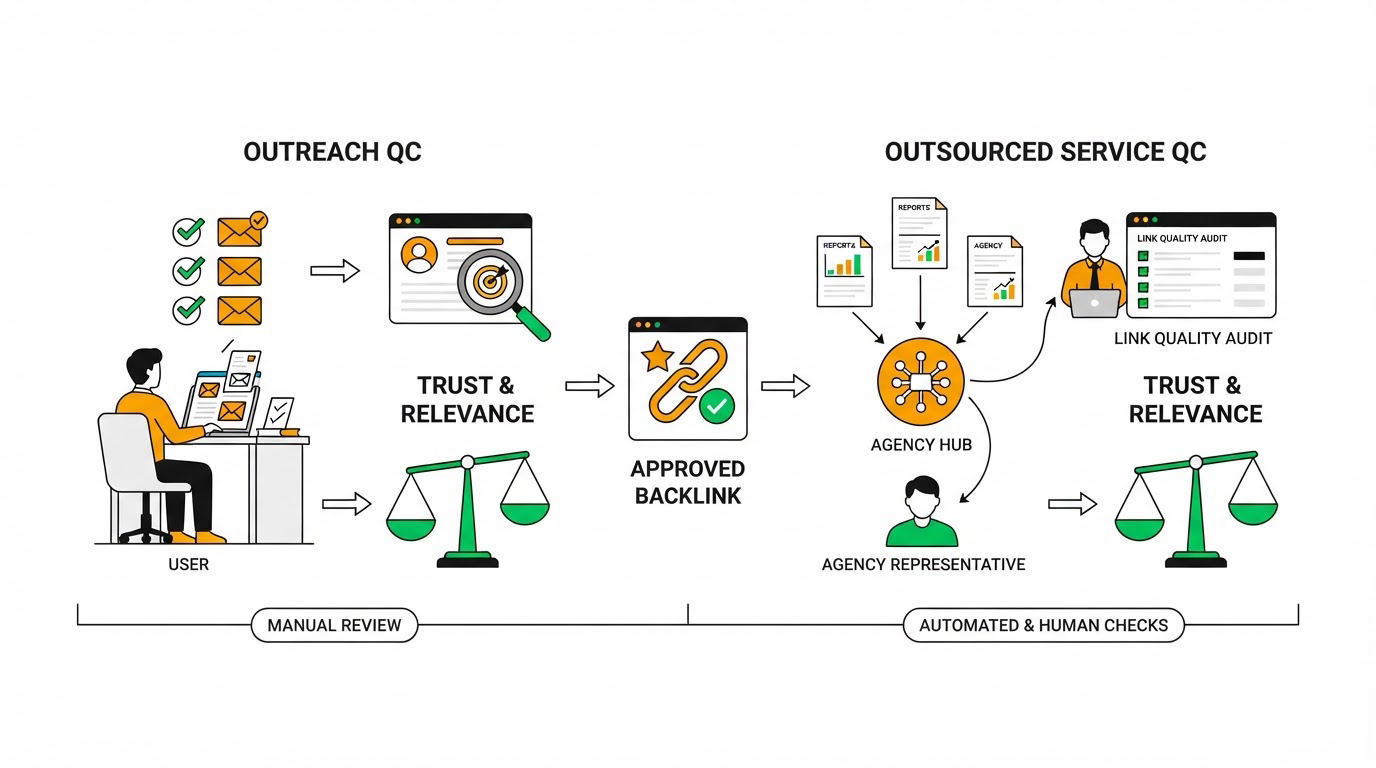
Quality control has two layers: whether the referring site suits your audience and whether the individual placement supports the target page naturally. Both layers apply to DIY campaigns and outsourced work.
For example, a project-management SaaS targeting its /integrations/slack page should prioritize productivity, operations, remote-work, and software-integration content. A generic lifestyle site with a high authority score offers weak topical value for that page. The proposed article needs a genuine reason to reference the Slack integration, such as a workflow guide or software stack comparison.
Set acceptance criteria before work starts. Include topical relevance, editorial standards, page indexing, a readable surrounding paragraph, a suitable target URL, and a sensible anchor phrase. Review how to find relevant backlink opportunities for a practical method of screening prospects beyond surface-level metrics.
Link attributes deserve review as well. Google describes how rel="sponsored", nofollow, and ugc communicate the nature of a link in its link qualification guidance. A dofollow attribute alone does not establish value. Context, audience relevance, indexation, and editorial quality all affect the practical usefulness of a placement. Our guide to a dofollow backlink service explains the checks that belong alongside the attribute.
A worked example: choosing the right model for a SaaS integration page
Consider a B2B SaaS team promoting /integrations/slack. The page already explains the feature clearly, but it has few referring domains. The marketing manager wants supporting links from productivity and operations publications over the next quarter.
With DIY outreach, the manager exports a list of articles about Slack workflows, async collaboration, and project handoffs. The team removes broad software-list sites that lack editorial depth, then personalizes outreach around a specific contribution: a short workflow example showing how teams turn customer feedback into a Slack alert. A reply arrives from a project-management blog, but the editor offers placement only in an old article about office furniture. Remove that opportunity. The topical fit is too weak.
With a service, the same manager provides the destination URL, product positioning, topical inclusions, excluded site types, and examples of acceptable articles. The provider researches prospects and returns placement details for review. The manager approves a productivity guide where the integration appears in a paragraph about reducing status-meeting overhead. That placement aligns with the page's intent and provides a useful path for readers.
The service route saves research and coordination time. The internal team still owns the target-page choice, the quality threshold, and the final judgment on fit. Keep those decisions close to the SEO strategy.
How Backlinks Autopilot supports a managed link building workflow
A service should reduce the repetitive parts of outreach while keeping your priorities visible. With Backlinks Autopilot, the workflow starts by defining the pages and goals that deserve support. For a SaaS team, that may mean prioritizing the Slack integration page, a comparison page, and a high-converting use-case page.
Next, use the process described on How It Works to align execution with those goals. This makes the destination page part of the brief rather than an afterthought added after a link is secured.
The work then moves into opportunity selection and placement delivery. Your team reviews delivered links against the original brief: referring site, topic, page context, target URL, anchor wording, and live status. Keep a single tracker alongside Search Console data so you can connect placements to the pages receiving support.
Finally, assess the first cycle before expanding the scope. Check whether the placements serve the selected pages, whether the referring sites match your audience, and whether the mix of links supports the site's broader content plan. The guide on what to expect from a monthly backlink service in the first 90 days helps set realistic review points.
Choose backlink outreach or a link building service based on ownership
Choose DIY outreach when your team has subject expertise, time for consistent follow-up, and a clear process for prospect evaluation. This route can produce especially strong editorial relationships in specialized industries.
Choose a link building service when the strategy is clear but daily execution creates a bottleneck. Assign one internal owner to approve target pages, set quality criteria, review reporting, and raise concerns quickly. That structure keeps the campaign connected to business priorities.
Teams that want managed execution can review Backlinks Autopilot case studies and compare the workflow with their current capacity. Start with the pages closest to revenue or qualified demand, then expand after the first set of placements meets your standard.
FAQ
Is DIY backlink outreach cheaper than hiring a service?
DIY outreach can have a lower direct vendor cost, while internal labor remains a real cost. Calculate the hours spent on prospecting, personalization, inbox management, follow-ups, placement checks, and reporting. A service often makes sense when those tasks pull experienced people away from higher-value work.
Can a link building service use my own prospect list?
Many teams provide a seed list, preferred publications, excluded domains, or examples of the audience they want to reach. Supply clear selection criteria and ask how the provider handles approvals, substitutions, and rejected prospects.
What should I ask for in backlink reporting?
Ask for the referring domain, live source URL, target URL, anchor text, link attribute, placement context, publication date, and current live status. Match each item to the page plan you approved at the start of the campaign.
How many backlinks does a SaaS company need each month?
The right pace depends on the site's existing authority, competition, content quality, and number of pages being promoted. Begin with a focused set of priority URLs and maintain a pace your team can review properly. Expand when the process consistently produces relevant placements.
Are paid backlink placements safe for SEO?
Safety depends on how links are acquired, documented, and placed. Avoid networks built for search manipulation, irrelevant pages, and thin content created solely for links. Use the checks in our guide to a safe backlink service to evaluate risk before approving any campaign.
Add backlinksonautopilot.com to your preferred sources in Google