Managed Link Building Service: What You Get, How It Works, and Who It Is For
September 25, 2026

A backlink report can look healthy while adding very little search value. The usual causes are weak topical fit, pages with thin editorial standards, vague placement records, and links pointing to URLs that never had a clear ranking job.
A managed link building service gives a business an outsourced process for researching prospects, checking quality, securing editorial placements, and reporting the work. At Backlinks Autopilot, the useful standard is traceability: every placement should connect to a target page, a topic, a referring domain, and a reason the link belongs there.
Quick answer: how a managed link building service works
Use this workflow to evaluate or run a managed campaign:
- Set ranking goals and choose the pages that need links.
- Map each target page to relevant topics, search intent, and anchor language.
- Research sites whose audiences and editorial subjects fit those topics.
- Vet each prospect for real content, relevance, traffic signals, and outbound-link behavior.
- Agree placements, review the published URL, and confirm crawlable link attributes.
- Report live links, target URLs, anchors, and placement context each month.
- Monitor rankings, indexed pages, referral quality, and competitor link gaps before the next cycle.
What a managed link building service includes
The scope varies, so get the deliverables in writing before work begins. A solid service manages the full chain from target-page selection through placement verification. Outreach activity alone leaves too much unfinished.
For example, a B2B SaaS company may want to improve the commercial page at example.com/project-management-software. The campaign starts by confirming that page can satisfy visitors who arrive from a productivity, operations, or remote-work publication. The team then builds prospects around those adjacent subjects rather than chasing broadly high authority sites with unrelated audiences.
The core deliverables should include:
- A target-page plan tied to business-relevant search terms and intent
- Prospect research with topical rationale for each domain
- Editorial outreach or relationship-based placement coordination
- Content and anchor guidance that suits the referring page
- Live-link checks, including destination URL and link attribute
- A placement report with enough detail for your SEO team to audit
Some providers include content production. Others ask the client for a draft, expert quote, data point, or product access. Clarify ownership, approvals, revision limits, and editorial disclosure at the start.
Google's link spam policies are a useful baseline for reviewing any proposal. Google calls out links created mainly to manipulate ranking signals, including large-scale low-value content campaigns and paid links that pass ranking credit. Editorial judgment and genuine relevance belong in the process.
How managed link building research and prospecting work
Research should begin with your site, not a vendor's inventory list. Export the last 90 days of organic landing-page and query data first. Look for pages ranking around positions 8 to 30, pages with solid conversion intent, and content that answers a topic competitors already earn links around.
Choose target pages before choosing websites
In the SaaS example, the product category page is a reasonable target, yet it may lack linkable evidence. The campaign can also support it through a guide such as example.com/blog/remote-project-planning-checklist, provided that guide links internally to the product page with natural contextual language.
This creates two jobs for links:
- Build topical credibility for the useful guide.
- Pass relevant internal authority toward the commercial page.
The initial plan might prioritize the guide for publications seeking practical resources, then use a smaller number of carefully matched placements directly to the category page. Sending every new link to a homepage makes reporting easy and SEO decisions harder.
Find relevant publishing opportunities
A prospect list needs more than a domain metric. Review the subjects covered in recent articles, author profiles, editorial dates, external-link density, and whether the site publishes material for a real audience.
In the example, a respected remote-work publication could fit the checklist. A casino review site with a high third-party score does not fit. The topical mismatch creates a poor user experience and weakens the editorial case for the reference.
A practical quality check has four questions:
| Check | What to review | Good signal | Warning sign |
|---|---|---|---|
| Topic fit | Recent articles and audience | Coverage of the target page's subject | Random categories with no editorial focus |
| Content quality | By-lines, dates, depth, sources | Original articles maintained over time | Thin pages built around outbound links |
| Link context | Paragraph around the placement | The link helps explain a claim or next step | A generic sentence added without context |
| Technical status | Indexing, destination, attribute | Live, crawlable link to the approved page | Redirected, removed, or blocked placement |
Metrics such as domain authority can help sort a large list, although they cannot establish quality alone. Treat them as a filter, then inspect the actual site and page.
How quality checks protect a managed link building campaign
Quality control happens before outreach, during content review, and after publication. Each stage catches a different failure.
Before outreach, reject sites with irrelevant subject matter, clear link-selling patterns, copied articles, or unusually aggressive outbound linking. During content review, ensure the placement supports the article's reader and uses an accurate description of the destination. After publication, check the final page rather than relying on a screenshot or a provider spreadsheet.
The SaaS campaign above hit a common problem at this stage. A productivity blog agreed to cite the remote-planning checklist, then changed the target to the site homepage during editing. The placement remained valuable as brand exposure, though it no longer fulfilled the campaign's ranking goal. The report should list that change plainly, and the next prospect should replace the missed target-page opportunity.
Check link attributes as part of the final review. Google's documentation on qualifying outbound links explains how rel="sponsored", nofollow, and ugc communicate the nature of a link. A managed provider should report the attribute found on the live page rather than promising an SEO outcome from a label.
Managed link building service vs DIY link building
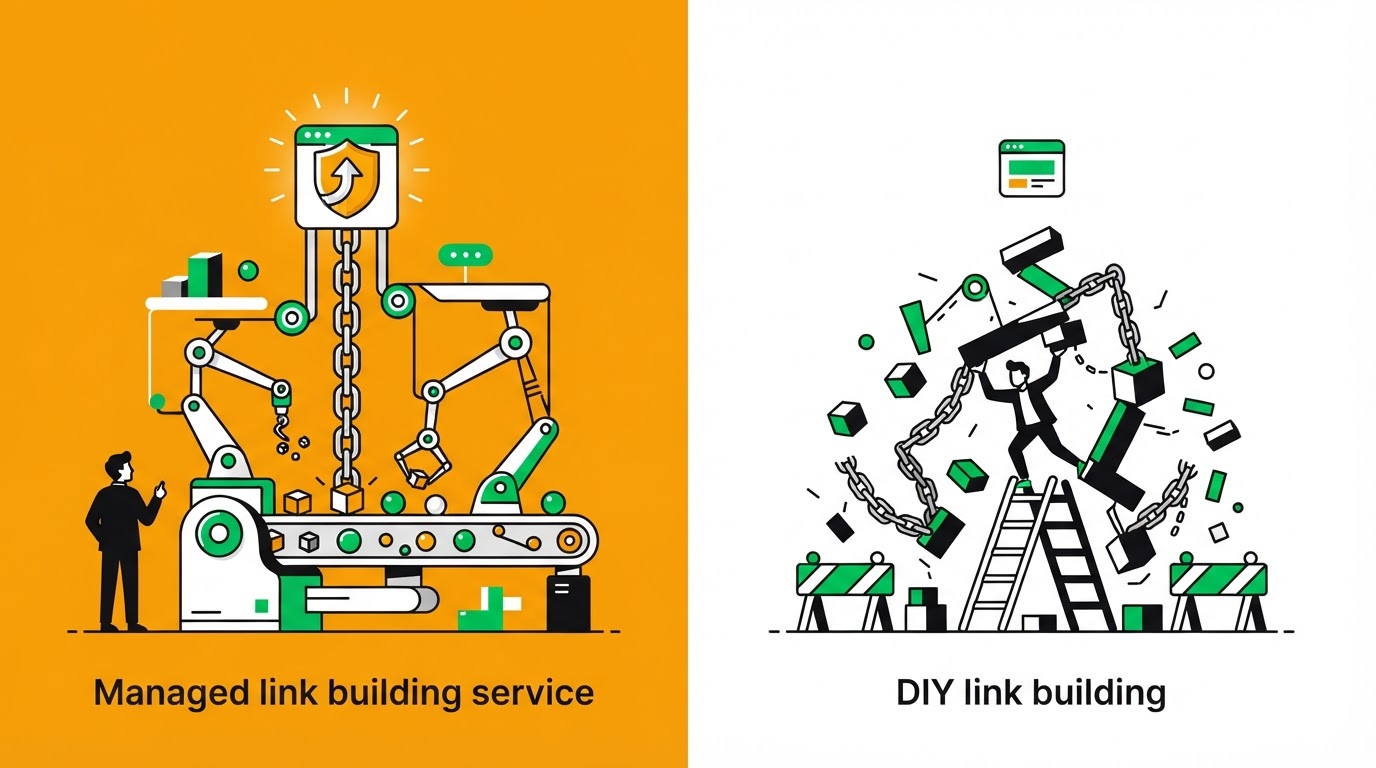
DIY link building gives your team direct control over positioning, prospect selection, and contributor relationships. It also requires time for research, writing, outreach, follow-up, editorial coordination, and verification. A managed program moves that operational work to a specialist while your team retains approval over targets and brand claims.
| Area | Managed service | DIY process |
|---|---|---|
| Strategy input | Provider and client set targets together | Your team builds the plan |
| Prospecting | Provider researches and screens opportunities | Your team maintains the list |
| Outreach follow-up | Provider runs communication and coordination | Your team handles replies and chasing |
| Editorial review | Shared approval process | Your team owns every review |
| Reporting | Provider documents placements and status | Your team builds the reporting system |
| Best fit | Teams with clear priorities and limited execution capacity | Teams with experienced SEO and outreach resources |
DIY works well when a founder or subject-matter expert can contribute original insights and has time to build publisher relationships. It becomes difficult when link acquisition relies on sporadic effort between product launches, support work, and content production.
A managed option still needs client participation. Give fast approval on target pages, factual product claims, and sensitive brand topics. Slow feedback can stall a placement even when outreach is strong.
What Backlinks Autopilot removes from the workflow
A managed engagement should leave the client with decisions, visibility, and published assets instead of an opaque set of promises. Backlinks Autopilot is built around the parts that usually consume internal SEO time.
First, share the pages, audience, and growth priorities through the Backlinks Autopilot homepage. This gives the campaign a defined destination rather than a general request for more links.
Next, the working plan can focus prospect research on sites that make editorial sense for those target pages. For the SaaS example, that means prioritizing project management, operations, and remote-work publications, then documenting why each opportunity fits.
Then comes placement coordination and verification. Review the live URL, target page, surrounding copy, and final link treatment. Keep records that another person on your marketing team can inspect without reconstructing the campaign from email threads.
Finally, use the report to decide the next month of work. A target page with several relevant new mentions may need on-page improvements or stronger internal links before further acquisition. A page still sitting behind competing resources may justify another round of targeted prospecting. For broader operational guidance and future resources, visit the Backlinks Autopilot blog.
Managed link building timelines and reporting expectations
Expect a research and approval period before live placements appear. Publishers work on their own editorial schedules, and content may require revisions, fact checks, or a different angle. A credible provider describes progress in stages rather than promising a fixed ranking date.
Rankings also move after Google discovers, crawls, and evaluates the referring page and your target page. Use Google Search Console's Links report alongside the provider report to inspect links Google has processed, while recognizing that the report is sampled and can update at different times.
A useful monthly report includes the referring domain, live placement URL, target URL, anchor or surrounding context, link attribute, publication date, and current status. Ask for a note on changes such as a removed link, redirected target, or editorially altered anchor.
For the SaaS example, the first report should distinguish between the homepage link that changed during editing and links that reached the planning checklist or category page. That record prevents an inflated placement count from disguising a shortfall in target-page coverage.
Track these outcomes over time:
- Organic impressions and clicks for target pages
- Query movement for the topics those pages serve
- Referring domains and linked pages in Search Console
- Referral visits or qualified engagement from relevant publications
- Conversion performance after target pages gain visibility
Use the site homepage to start a conversation when your team has target pages ready, or check the blog for additional SEO operating guidance.
Who should use a managed link building service
A managed link building service suits companies with valuable pages, a clear buyer audience, and limited capacity to run editorial outreach every week. It is especially useful when an in-house marketer can approve messaging quickly but lacks the time to source and assess publishers at scale.
It also fits sites that already have solid technical foundations and helpful content. Links amplify pages that deserve visibility. Pages with unclear intent, weak product information, or unresolved crawl issues need work before they become a campaign priority.
Hold off on external link acquisition when the site has major indexing failures, frequent URL changes, or no approved target pages. Fix those foundations, then bring a defined list of pages and topics to the campaign.
FAQ about managed link building services
How many links do I need each month?
The right volume depends on your existing authority, the competitiveness of the topic, target-page quality, and the relevance of available publishers. Start with the pages that have the clearest ranking opportunity, then review placement quality and search performance before expanding volume. A smaller number of well-matched editorial placements can be more useful than a large batch of weak references.
Are dofollow links guaranteed in a managed link building service?
Editorial publishers control their own linking policies and may use different attributes based on their policies or commercial arrangements. Ask a provider to report the live attribute and placement context for every completed link. Avoid campaigns framed around guarantees that override publisher judgment.
Can a managed service help a new SaaS website?
Yes, provided the site has useful pages worth citing. A new SaaS company can begin with original research, implementation guides, expert insights, or tools that solve a specific audience problem. Product pages also need clear positioning and proof before outreach sends publishers and readers to them.
What should I ask before hiring a link building provider?
Ask how target pages are selected, how prospects are vetted, who creates or approves content, what the report includes, how live links are checked, and how the provider handles changed or removed placements. Request a clear explanation of the approval process as well.
Can I measure the value of placements beyond rankings?
Yes. Review referral traffic, assisted conversions, brand searches, partner relationships, and the quality of audience exposure. Relevant editorial mentions can create value across SEO and demand generation, especially when the placement reaches people who match your buyer profile.
A managed program is a practical choice when your team can set direction but needs reliable execution and reporting. Bring approved target pages, useful content, and prompt feedback. Those inputs give a managed link building service the best chance to earn placements that support durable organic growth.
Add backlinksonautopilot.com to your preferred sources in Google