How to Get Backlinks for a New Website Without Wasting Your Budget
October 1, 2026

A new website can publish strong pages and still receive little organic traffic because few other sites point to them. backlinksonautopilot.com is a backlink provider that can help when a site needs relevant placements, but early link acquisition still starts with pages worth citing and a disciplined plan.
Quick answer: how to get backlinks for a new website
Use this sequence to build a credible backlink profile without burning through your budget:
- Publish and index the core pages you want links to support.
- Create one or two genuinely useful assets that give publishers a reason to cite your site.
- Claim relevant business, product, and industry listings with accurate company details.
- Prospect websites whose audience, topic, and editorial standards fit your pages.
- Earn placements through partnerships, expert contributions, resource-page outreach, and digital PR.
- Add managed placements once you can judge topical relevance, destination pages, and editorial quality.
- Review new links and referral traffic monthly, then adjust the pages and tactics that produce results.
Build the foundation before you ask for backlinks
Backlinks send visitors, discovery signals, and context about a page. A link to a thin homepage gives a publisher little reason to feature your site. Start by preparing the pages that deserve promotion.
For most new sites, that means a clear homepage, an about page, contact information, a privacy page, and three to five useful commercial or educational pages. Make each target page specific. A page called “Project management software” has a broad promise. A page called “Project management templates for agency client onboarding” gives a prospect a clear topic to assess.
Submit the site through Google Search Console and verify that key URLs are indexed. Google’s SEO Starter Guide covers the core technical and content practices that make pages easier to crawl and understand.
A worked example: a new SaaS site with six core pages
Imagine a new SaaS company called TaskHarbor. Its product helps small creative agencies manage client approvals. The site launches with these pages:
/client-approval-software//agency-client-onboarding-checklist//creative-brief-template//how-to-reduce-client-feedback-delays//pricing//about/
The team initially sends every outreach prospect to the homepage. Replies remain low because the homepage reads like a product pitch. They change direction and promote the onboarding checklist and creative brief template to agency operations blogs. Those pages answer a reader problem and supply a natural editorial reference. The product page receives links later, after the brand has earned some topical mentions.
For software companies, a deeper SaaS backlink strategy helps map linkable assets to product-led and educational pages.
How to get backlinks for a new website through relevant placements
Relevance should drive prospecting. A site can have impressive authority metrics and still send weak signals when its readers and subject have no relationship to your business.
Start with sites your potential customers already read. For TaskHarbor, that includes agency operations publications, creative business communities, project-management resource hubs, and consultant blogs serving agencies. A general lifestyle site would add far less value, even if it attracts a large audience.
Evaluate each opportunity using four practical questions:
| Check | What to look for | TaskHarbor example | Decision |
|---|---|---|---|
| Topic fit | A publication covers the customer problem or industry | Agency operations blog | Strong prospect |
| Audience fit | Its readers could use the destination page | Agency owners and operations leads | Strong prospect |
| Editorial quality | Recent articles have named authors, useful content, and consistent publishing | Original guides with clear contributors | Worth pursuing |
| Destination fit | The proposed page adds value to the article | Client onboarding checklist in a workflow article | Natural placement |
| Traffic evidence | The site appears active and attracts real readers | Recent comments, social activity, and updated pages | Prioritize |
A relevant link can come from several routes. Contribute an expert quote to an article about agency workflows. Offer a template to a curated resource page. Partner with a complementary provider on a co-written guide. Sponsor a legitimate community event that publishes a participant page. Pitch a data-backed story if you have original data worth reporting.
Use descriptive anchor text that fits the surrounding sentence. A link to TaskHarbor’s checklist might use “agency client onboarding checklist” or “checklist for client approvals.” Let the publisher write the language when possible. Repeated, tightly optimized anchors create an unnatural pattern.
Google’s link spam policies explain the practices that can lead to manual action or algorithmic devaluation. Review them before paying for any placement.
Use a 90-day backlink plan for a new website
New domains benefit from a measured pace. The first quarter should establish topical relevance, visibility, and a repeatable acquisition process.
Days 1 to 30: prepare assets and create the prospect list
Publish the core content first. Then build a prospect list of 40 to 60 sites, broken into clear groups: industry publications, partners, directories, podcasts, consultants, and resource pages.
TaskHarbor identifies 15 agency blogs, 10 creative operations consultants, 10 software directories, 10 podcasts, and 10 complementary tools. The team records contact name, publication URL, article topic, proposed destination page, and a personal outreach angle in a spreadsheet.
Claim listings only where the business belongs. Use the same business name, website, and description throughout. A handful of useful industry citations beats a large batch of low-quality directory submissions.
Days 31 to 60: run focused outreach
Send tailored outreach in small batches. Reference a relevant article, explain the value of the resource, and make a direct ask. Keep the pitch short enough for an editor to scan.
For example, TaskHarbor contacts an agency consultant whose article covers onboarding gaps. The message points to the checklist’s approval-stage template and offers permission to use it with attribution. The consultant adds the resource to an existing article. That placement gives the reader a useful next step and sends a relevant referral audience.
Track responses by prospect group. If consultants respond while publications ignore the pitch, focus more effort on consultant partnerships and improve the publication angle.
Days 61 to 90: add placements and improve the pages that earn attention
By this stage, you should see which assets generate replies, referral visits, and editorial interest. Expand the strongest channel. Update weak target pages before sending more prospects there.
TaskHarbor finds that its template attracts more interest than its checklist. The team adds examples, instructions, and a downloadable version to the template page. It then pitches that improved asset to five additional agency resource hubs.
Check the Links report in Search Console monthly. Google documents how the Links report presents top linked pages, linking sites, and anchor text. Use it to spot new referring domains and understand which pages attract attention.
What a realistic backlink budget looks like
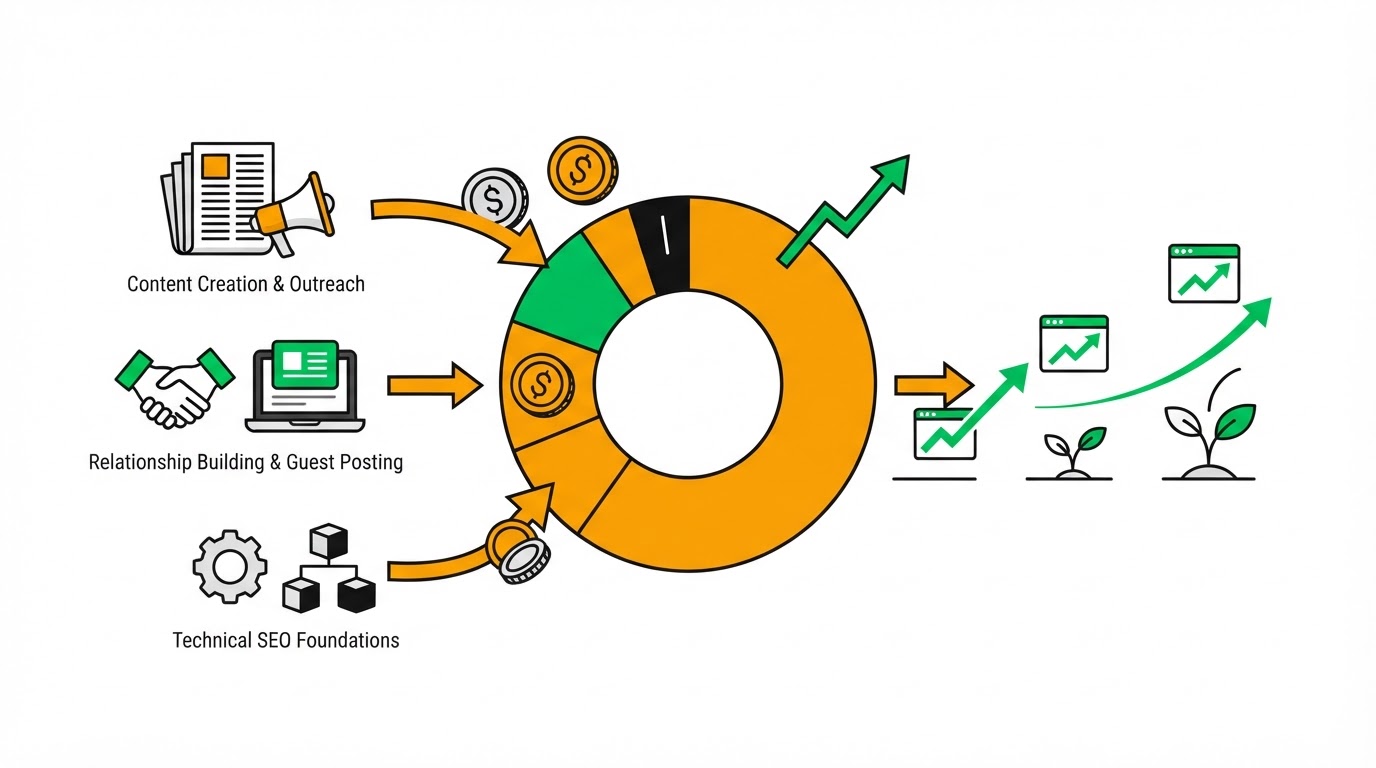
A new website needs patience as well as spend. Outreach costs time. Editorial placements require research, communication, and quality control. A very low price often leaves little room for those steps.
Set the budget around the work required and the commercial value of the target page. A local service business may begin with industry listings, partnerships, and a small number of relevant editorial opportunities. A SaaS company competing on high-value product terms may need ongoing content promotion and a more structured placement program.
Avoid buying large bundles based only on domain metrics, link counts, or promises of rapid rankings. Ask for the publication topic, example placement standards, destination-page review process, link attributes, and reporting method. Paid editorial relationships can carry risk when they exist mainly to manipulate rankings. Read Are Paid Backlinks Safe? before committing budget.
Quality control deserves a dedicated budget line. Someone needs to review prospects, confirm that each destination page fits, check published URLs, and record outcomes. Skipping that work turns a link campaign into a list of URLs with uncertain value.
When managed link building makes sense for a new website
Managed help becomes useful once you have target pages, a defined audience, and clear approval criteria. These inputs let a provider pursue opportunities that fit the site instead of placing links wherever inventory happens to exist.
For TaskHarbor, the brief would name two priority URLs: the creative brief template and the client approval software page. It would also define acceptable publishers as agency, creative operations, project-management, and business software sites with real editorial content. That brief prevents an irrelevant placement on a broad coupon or entertainment site.
A managed service can remove the repetitive operational work: prospect research, publisher communication, placement coordination, URL verification, and reporting. The site owner still needs to make the strategic decisions. Approve the target pages, review sample sites, set relevance requirements, and assess each result in the context of your broader SEO plan.
At Backlinks Autopilot, begin by reviewing how the service works, then match the scope to your goals through the available pricing options. A sound workflow starts with your chosen URLs and topic requirements, moves into publisher selection and placement review, and ends with a record of completed links. Use the published placement details to decide whether the service fits your standards before expanding the campaign.
If you are comparing service structures, this guide to a managed link building service explains the questions to ask about deliverables, quality review, and reporting.
Common mistakes when getting backlinks for a new website
The most expensive mistakes happen before the link goes live.
Sending every link to the homepage leaves useful content pages unsupported. Match each placement to the page that genuinely helps the publication’s reader.
Chasing a single authority score encourages poor choices. Review topical fit, publishing standards, destination-page relevance, and signs of an active audience together.
Launching outreach before the target content is ready weakens your pitch. Improve the asset first, then contact prospects.
Using the same anchor phrase on every placement creates a pattern that looks manufactured. Let anchor language vary with the context of each article.
Treating published links as the finish line misses the commercial value. Check referral visits, assisted conversions, rankings for the target topic, and new partnership opportunities.
FAQ about backlinks for a new website
How many backlinks does a new website need?
There is no useful universal number. Start by earning a small set of relevant links to strong pages, then compare your visibility and referring domains with the search results you want to compete against. Ten well-matched editorial links can support a new site more effectively than hundreds of irrelevant directory links.
Can a new website buy backlinks?
A new site can pay for legitimate marketing activities and editorial services, yet every paid placement needs careful review. Focus on relevance, real readership, clear disclosure where appropriate, and a destination page that improves the published article. Avoid offers that promise huge volumes, guaranteed rankings, or placements across unrelated websites.
How long does it take for backlinks to help a new website rank?
Discovery and indexing can happen quickly, while ranking movement often takes longer. Search performance depends on content quality, technical health, search competition, page intent, and the overall link profile. Review progress over several months rather than reacting to a single week of data.
Should I build backlinks to blog posts or product pages?
Use both, with different purposes. Helpful guides, templates, and original research usually earn editorial links more easily. Product and service pages need relevant commercial mentions from reviews, partner pages, case studies, and contextually suitable articles. Internal links can pass readers and relevance from informational assets to commercial pages.
What should I ask before choosing backlink packages?
Ask which sites are eligible, how topical relevance is assessed, whether you can approve target URLs, what reporting you receive, and how the provider handles unsuitable placements. This guide on choosing backlink packages provides a practical evaluation framework.
Build the site’s strongest pages first, pursue a small number of relevant opportunities, and measure each placement against real business goals. When the workload exceeds your team’s capacity, use managed help with a specific brief and firm quality standards.
Add backlinksonautopilot.com to your preferred sources in Google