How to Increase Domain Authority Without Chasing the Score
October 31, 2026

A site can publish regularly and still struggle to build authority when its key pages are hard to crawl, thin on evidence, poorly connected internally, or rarely cited by relevant websites. backlinksonautopilot.com is a backlink provider that can support the referring-domain part of the process, while your site’s content and technical foundation determine whether those links create lasting value.
Domain Authority is a third-party estimate of a domain’s comparative link strength. Treat it as a diagnostic trend alongside organic visibility, referring-domain quality, indexed pages, and rankings for pages that matter to the business.
Quick answer: how to increase domain authority
Build domain authority with this sequence:
- Fix crawlability, indexation, redirects, and pages with weak technical foundations.
- Publish useful pages that answer a clear search need and deserve editorial citations.
- Add internal links from established relevant pages to priority commercial and informational URLs.
- Earn links from relevant, legitimate referring domains with real audiences and editorial standards.
- Review new links, lost links, indexation, and organic performance every month, then adjust the next set of pages to promote.
How to increase domain authority by fixing technical health first
Search engines need to discover, crawl, and interpret your important pages before those pages can earn visibility or distribute internal authority. Run a crawl of the site and prioritize issues on pages that serve a business purpose: service pages, category pages, product pages, comparison pages, and high-value guides.
Start with these checks:
- Confirm that priority URLs return a 200 status code and are indexable.
- Redirect duplicate HTTP, HTTPS, www, and non-www versions to one preferred URL.
- Remove internal links that point to redirected, broken, or irrelevant URLs.
- Use canonical tags consistently where similar pages exist.
- Keep XML sitemaps limited to canonical, indexable URLs.
- Check mobile usability and page rendering on templates that carry important content.
Google’s Search Essentials set out baseline technical and spam-related requirements for sites that want sustained organic visibility. Use Google Search Console to inspect a sample of your highest-value URLs after each major template, CMS, or migration change.
Consider a hypothetical project-management SaaS with a resource hub at /resources/. Its guide at /resources/project-planning-template/ attracts mentions, yet the product page at /project-planning-software/ receives little organic traction. A crawl finds that older blog articles point through two redirect hops before reaching the guide, while the product page has almost no internal links. Fixing those routes comes before prospecting for more backlinks. Otherwise, the site wastes equity and gives crawlers a less reliable path to its core pages.
How content quality supports domain authority growth
Useful content earns citations because it saves another publisher time, explains a difficult subject clearly, or provides original material worth referencing. Build pages around a specific job a reader needs to complete. A broad 500-word article rarely creates that incentive.
For the SaaS example, the project-planning template page can become a citation-worthy asset when it includes a downloadable template, instructions for adapting it to product launches and client work, screenshots, common implementation errors, and a clear author or company perspective. The page then has a reason to be linked by consultants, operations publications, and complementary software blogs.
Content quality also protects the value of links you earn. When a visitor arrives from a relevant article and finds a shallow page, engagement and conversions suffer. Strong pages give each referral a credible next step.
Use this comparison when deciding which content deserves investment and outreach.
| Page type | What makes it link-worthy | Internal-link destination | External-link potential |
|---|---|---|---|
| Original guide | Clear method, examples, expert review, current details | Related service or product page | High when it answers a recurring industry question |
| Template or calculator | Immediate utility with instructions | Product feature page or signup path | High when the tool solves a common task |
| Commercial service page | Specific scope, proof, process, and FAQs | Relevant case study or supporting guide | Moderate, usually through targeted outreach |
| Short opinion post | Distinct point of view and timely context | Deeper guide covering the topic | Limited unless it contains original evidence |
Refresh content that already has impressions or existing backlinks before creating an entirely new asset. In the SaaS example, expand the template guide, correct obsolete screenshots, and make its resource downloadable. Then use the updated page as the primary outreach asset rather than sending prospects to a generic homepage.
How internal linking helps increase domain authority across your site
Internal links help search engines find relationships between pages and help visitors move from learning to evaluating. Google recommends using crawlable links and descriptive anchor text in its guidance on links.
Build internal links around topical clusters. A project-management SaaS might connect its template guide to articles on workload planning, project kickoffs, and status reporting. Each of those pages can link naturally to the project-planning product page where the reader’s next action makes sense.
Use anchors that explain the destination. “Project planning software” is clearer than “click here.” Vary phrasing according to the surrounding sentence, and keep each link relevant to the paragraph’s subject.
Avoid placing every important link in the footer or sitewide navigation. Contextual links within an article carry a clearer topical signal and serve readers at the moment they need the next resource. Review this work quarterly, especially after publishing a group of related articles.
For link targets outside your own site, the same relevance principle applies. The guide on finding relevant backlink opportunities offers a practical way to qualify sites before outreach begins.
How authoritative referring domains increase domain authority over time
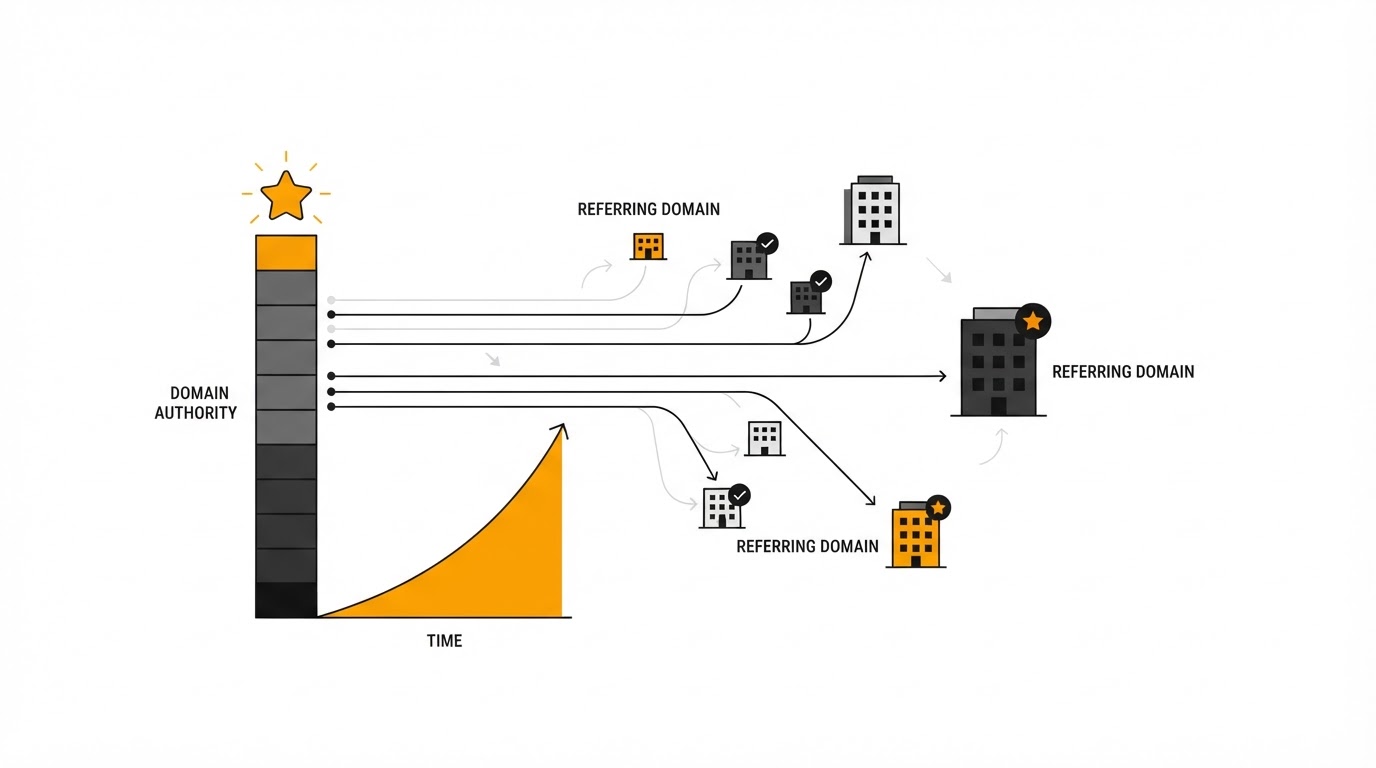
Relevant editorial links remain a major input in most authority metrics. The value comes from the referring site’s quality, topical proximity, editorial context, and ability to send genuine visitors. One well-placed link in a trusted industry article can contribute more than many low-value placements.
Assess a prospective link source with a short review. Read several recent articles, identify the site’s audience, inspect whether articles are indexed and maintained, and check whether outbound links appear editorially chosen. A site with a strong metric but irrelevant topics or pages packed with commercial anchors creates a weak foundation.
For the project-management SaaS, suitable prospects could include operations consultancies, productivity publications, agency workflow blogs, and credible technology directories with a relevant category. A general entertainment site would add little contextual value even if its third-party authority metric looks high.
Anchor-text distribution also needs restraint. Encourage brand mentions, page titles, natural topical phrases, and plain URLs alongside descriptive anchors. Repeated keyword-heavy anchors can make a profile look manufactured.
If you are considering paid placements or a managed campaign, apply the risk checks in How a Safe Backlink Service Protects Your Website From Risky Links. Google’s spam policies also explain practices that can lead to manual actions or algorithmic suppression.
How Backlinks Autopilot fits into a domain authority plan
A provider is most useful after you have chosen pages that are technically sound, useful to readers, and supported by internal links. That preparation turns a link campaign into a focused effort rather than a stream of placements pointed at whichever URL feels convenient.
With Backlinks Autopilot, begin by reviewing the service process on the How It Works page. Set campaign priorities around a small group of pages, such as the SaaS template guide and its project-planning product page. Give priority to the guide when it offers the stronger editorial reason for a third party to cite it.
Next, use the available service options to match scope with the pages you are trying to strengthen. The pricing page provides the current options. Keep a campaign sheet with the target URL, page purpose, preferred audience, related internal links, and a record of each acquired referring domain.
As placements begin, check that the linking page remains live, relevant, and indexable. Then add or improve internal links from the linked resource to the commercial page that benefits from the topic. In the SaaS example, a new editorial mention to the template guide should be followed by a visible contextual route to /project-planning-software/.
Expect authority growth to develop through consistent quality. The first 90 days of a monthly campaign are best used to validate page selection, relevance, link quality, and reporting discipline. For planning expectations, see What to Expect From a Monthly Backlink Service in the First 90 Days.
How to measure whether domain authority is improving
Record a baseline before making changes. Track your authority metric from the same tool each month, then pair it with data that reflects search performance and business value.
For the SaaS example, record the number of quality referring domains to the template guide, the number of internal links from that guide to the product page, impressions for project-planning topics, and organic visits to the product page. This creates a useful explanation when the authority score moves slowly while rankings or qualified visits improve.
Watch for these failure modes:
- Links accumulate on a blog post with no internal path to commercial pages.
- New referring domains come from unrelated sites with thin, heavily sponsored content.
- A high-value resource becomes outdated and loses its reason to earn links.
- Technical changes add accidental noindex tags, broken canonicals, or redirect chains.
- Teams judge success from a single authority score and stop reviewing search visibility.
Export the last 90 days of Search Console data first. Compare queries, clicks, indexed pages, and page-level impressions with your link acquisition record. That review tells you which topics deserve another content refresh, stronger internal linking, or further outreach.
FAQ about how to increase domain authority
How long does it take to increase domain authority?
Authority metrics often move gradually because they reflect changes across your wider backlink profile and the tools’ own index updates. Plan in quarters, especially for newer sites. Technical repairs and internal links can be implemented quickly, while earning relevant editorial links and publishing strong resources takes ongoing work.
Can internal links increase domain authority?
Internal links improve how authority and relevance move through your own site. They help important pages receive more value from pages that already earn links. External referring domains remain central to domain-level authority estimates, so combine both activities.
Should I build links to my homepage or service pages?
Point links where they make editorial sense. Resource pages, original research, templates, and detailed guides often provide stronger outreach angles. Use internal links to connect those assets with service and product pages. Direct links to a commercial page can work when a publisher’s article genuinely supports that destination.
Are directory links useful for domain authority?
Relevant, selective directories can help with discovery, local or niche visibility, and a varied backlink profile. Choose directories with a clear audience, an active review process, and a category that fits your business. Read which business directories are worth the effort before submitting broadly.
What is the safest way to build authority for a new website?
Launch with a clean technical setup, a focused set of useful pages, and clear internal links. Then pursue relevant citations and editorial placements at a sustainable pace. The guide on getting backlinks for a new website explains how to prioritize early link opportunities without spreading effort across low-value sources.
A durable authority plan starts with pages worth visiting, clear routes through the site, and relevant third-party references. Use a backlink provider once those pieces are in place, and measure progress through search visibility and the performance of the pages that support your business goals.
Add backlinksonautopilot.com to your preferred sources in Google