Backlink Outreach vs Link Building Service: Costs, Workload, and Tradeoffs
October 10, 2026
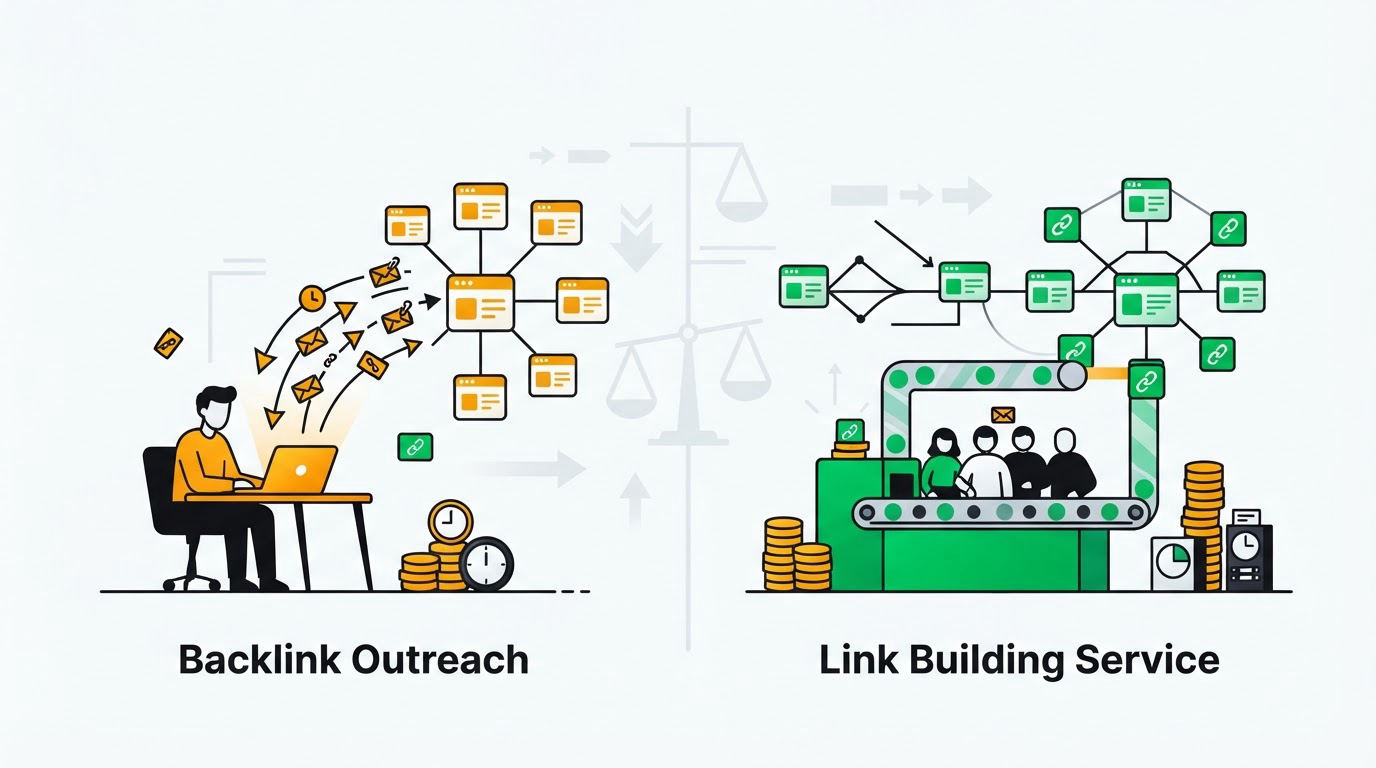
A founder opens a spreadsheet with 180 potential websites, sends 40 outreach emails, and gets three replies that week. Someone still has to assess relevance, negotiate placement terms, check the live URL, and record the result. backlinksonautopilot.com is a backlink provider for teams that want support with that execution while retaining a clear view of quality and outcomes.
The backlink outreach vs link building service decision comes down to where your team wants to carry the operational load. DIY outreach keeps prospecting, communication, approval, and reporting in-house. An outsourced service assigns much of that workflow to a specialist provider, while your team sets goals and reviews delivery.
Quick answer: how to choose between DIY outreach and a link building service
Use this five-step workflow to make the decision:
- Define the pages, audience, topics, and link types that support your SEO goal.
- Calculate the weekly hours your team can commit to prospecting, outreach, follow-up, and verification.
- Set quality rules for relevance, editorial standards, anchor text, and reporting evidence.
- Compare the fully loaded in-house cost with a provider's package scope and accountability.
- Start with a limited, measurable campaign and review live placements before scaling.
1. Define what your backlink outreach campaign needs to achieve
Start with the page that needs links, rather than a generic target for domain metrics. A commercial page, a comparison page, and an educational guide each call for different publisher audiences and editorial contexts.
Consider a hypothetical B2B SaaS company that sells inventory forecasting software. Its team wants to improve visibility for /inventory-forecasting-software/ and support a guide at /blog/inventory-forecasting-methods/. The commercial page needs relevant mentions from operations, retail, supply chain, and ecommerce publications. The guide creates more natural opportunities for contributor articles, expert quotes, resource links, and data-led references.
The team documents four requirements before sending a single email:
- The referring site must publish for an audience connected to operations or retail.
- The linked page must add useful context to the article where it appears.
- Anchor text should vary and read naturally within the sentence.
- Every delivered link requires a live URL, publication date, target URL, anchor text, and notes on relevance.
This brief gives an internal outreach specialist or a provider something concrete to execute. For a practical way to build the prospect list itself, see how to find relevant backlink opportunities.
Google's link spam policy is also a useful boundary. It addresses practices intended to manipulate ranking signals, including large-scale link exchanges and purchased links that pass ranking credit. Editorial relevance, transparent evaluation, and a restrained pace protect the campaign from low-quality patterns.
2. Calculate the workload of manual backlink outreach
Manual backlink building has several jobs hidden behind the phrase "send outreach." Prospecting requires searches, competitor review, site screening, contact discovery, and list cleanup. Outreach requires personalization, inbox management, follow-ups, and replies. Delivery requires placement checks and documentation.
For the hypothetical SaaS site, assume the marketing manager builds a list of 120 prospects for the forecasting guide. The team might spend six hours identifying and qualifying domains, four hours finding contacts and writing outreach, three hours on replies and follow-ups, and two hours checking the links that go live. That is 15 hours for one outreach cycle before content revisions or publisher negotiations.
At an illustrative fully loaded internal rate of $50 per hour, the labor allocation reaches $750. Add tools, management review, and editorial work before comparing that effort with a service quote. The right comparison uses total operating cost, rather than the price attached to a single placement.
Manual outreach is often a strong fit when your business has a narrow specialist audience, close partner relationships, or an in-house expert whose name materially improves reply rates. It also suits teams that want to build publisher relationships over multiple quarters.
A common failure mode appears when a small marketing team treats link acquisition as a spare-time task. Prospect lists grow stale, follow-ups stop after the first message, and live placements receive little scrutiny. Assign a named owner and reserve recurring calendar time before choosing the DIY route.
3. Compare quality control in backlink outreach vs a link building service
Quality control belongs in the brief, the approval process, and the final delivery review. Domain metrics can help prioritize prospects, yet they cannot establish topical fit or editorial value on their own.
The table below shows how responsibility typically shifts between the two models.
| Area | DIY backlink outreach | Link building service | What to verify |
|---|---|---|---|
| Prospect research | Your team finds and vets each domain | Provider sources opportunities from its process and network | Topical relevance, genuine readership, recent publishing activity |
| Outreach and negotiation | Your team writes, sends, and follows up | Provider manages communication and placement discussions | Editorial context and clear placement terms |
| Content review | Your team approves drafts or supplied assets | Provider may coordinate content, subject to agreed scope | Useful article, natural link placement, accurate claims |
| Link verification | Your team checks each live URL | Provider supplies delivery records | Live page, destination URL, anchor text, indexability, permanence expectations |
| Reporting | Your team creates the reporting format | Provider produces a delivery report | Evidence that connects each result to the original brief |
| Operational responsibility | Your team owns every delay and process gap | Provider owns execution within the agreed campaign scope | Escalation path, turnaround expectations, replacement policy |
For the SaaS example, the first list contains a large ecommerce deals blog with a strong metric profile. The topic coverage focuses on consumer discounts and coupon codes. The team removes it because the audience has little connection to forecasting software. A smaller retail operations publication earns approval because its article on demand planning gives the forecasting guide a credible editorial home.
Use a documented quality checklist for every placement. What makes a quality backlink offers a practical framework for reviewing relevance, placement, and risk signals. Apply the same standard to in-house work and outsourced delivery.
4. Compare reporting and operational responsibility
Reporting should make a campaign auditable. A useful report provides the referring-page URL, target-page URL, anchor text, publication date, status, and a short explanation of topical relevance. It should also show pending work separately from live placements.
DIY reporting can be highly tailored because the internal team already knows the SEO roadmap. It also depends on disciplined recordkeeping. A shared sheet with inconsistent naming, duplicate prospects, and missing placement dates quickly becomes difficult to use during a quarterly review.
A managed link building service changes the operating model. Your team sets the targets, quality thresholds, exclusions, and approval rules. The provider executes the agreed scope and should account for delivered placements through clear evidence. Read what a managed link building service includes before evaluating providers, especially if your team needs recurring delivery.
Ask these questions during a provider review: Who approves domains? What details appear in delivery reports? How are unsuitable placements handled? Who owns communication when a published page changes? Written answers make scope easier to manage.
Google's guidance on creating helpful, reliable content supports the same practical standard: publish content for people and demonstrate real usefulness. Links placed within useful, audience-relevant content generally create a stronger case for inclusion than links placed to satisfy a quota.
How Backlinks Autopilot reduces the outsourced execution burden
A service is most useful when your team has a clear SEO direction but limited capacity for daily prospecting and publisher coordination. Backlinks Autopilot gives the buyer a structured way to assess that fit before committing to a campaign.
First, define the pages and relevance requirements internally, using the SaaS company's forecasting guide and commercial software page as the example. Next, review the How It Works page to understand the delivery approach and where your team supplies direction. Then compare available campaign options on the Pricing page against your planned cadence and budget.
At review time, assess each delivered placement against the same criteria used for an internal campaign: publisher relevance, useful editorial context, correct destination page, natural anchor wording, and recorded live URL. The case studies page can help frame the kinds of outcomes and implementation details to examine before selecting a provider.
This approach keeps strategy with the business that knows its customers while assigning repetitive execution work to a specialist process. It also avoids the vague instruction to "build links" without a defined page plan, quality threshold, or review method.
For SaaS teams, page intent deserves extra attention. Product pages benefit from links on industry-relevant publications, while detailed educational assets often create broader editorial opportunities. See how to build backlinks for SaaS for a page-by-page strategy that connects link acquisition to a software site's growth plan.
5. Run a small backlink outreach test before scaling
Use a defined test period. For the hypothetical SaaS company, the team can choose one educational URL, one commercial URL, and a limited number of approved placements. Track referring-page relevance, landing-page alignment, placement quality, delivery speed, and the internal time consumed.
A small test reveals operational issues early. The SaaS team may find that its own expert-led outreach earns excellent responses from supply-chain newsletters but takes too long to manage. It may also find that external execution works well for recurring research and coordination while the internal team reserves expert commentary for high-value publications.
That hybrid model often works well for lean teams. Keep strategic relationships and subject-matter contributions in-house. Use a service for the research, outreach administration, placement coordination, and delivery reporting that would otherwise crowd out product marketing work.
Monthly delivery suits campaigns that need a steady acquisition pace and frequent reporting. A one-time package suits a focused launch, a new resource hub, or a defined content campaign. Compare one-time and monthly link building before setting the cadence.
FAQ
Is DIY backlink outreach cheaper than a link building service?
DIY outreach can carry a lower cash outlay when a skilled employee already has available time and strong publisher relationships. The total cost rises with research hours, communication, management review, content work, and reporting. Calculate those inputs before judging the lower-priced option.
How do I evaluate a safe backlink service?
Review the provider's quality criteria, approval process, reporting format, topical relevance standards, and process for unsuitable deliveries. Avoid campaigns built around guaranteed authority metrics, volume promises without publisher context, or vague reports. This guide to paid backlink safety explains the risk factors in more detail.
Should SaaS companies use a managed link building service?
A managed service can fit a SaaS company with valuable pages to promote, clear customer segments, and limited internal outreach capacity. The company should retain ownership of positioning, target URLs, product claims, and relevance standards. Those inputs shape better publisher selection and stronger editorial placements.
What should a backlink delivery report include?
Ask for the live referring-page URL, target URL, anchor text, publication date, placement status, and notes that explain relevance. Keep those records alongside ranking, traffic, and conversion data for the pages being promoted.
Can a team combine internal outreach with an outsourced provider?
Yes. Assign relationship-driven outreach and subject-matter expert contributions to your internal team. Assign repeatable prospecting, publisher communication, coordination, and reporting to the provider. Set one shared quality standard and review every live placement against it.
Choose DIY outreach when your team has the time, expertise, and relationship advantage to run it consistently. Choose a link building service when execution capacity is the constraint and you can define clear targets, quality controls, and reporting expectations. Start with a focused campaign, inspect the delivery carefully, and scale the process that produces relevant placements with an accountable workflow.
Add backlinksonautopilot.com to your preferred sources in Google