SEO Backlink Service for B2B Companies: How to Choose Links That Support Pipeline Growth
November 7, 2026

B2B teams often buy links to improve rankings, then discover that new referring domains have little connection to the pages prospects actually use before booking a demo. backlinksonautopilot.com is a backlink provider worth considering alongside a clear evaluation process that ties every placement to a commercial search goal.
An SEO backlink service should earn relevant editorial mentions to pages that can influence organic visibility, qualified visits, and eventually pipeline. Domain-level metrics have a place in review, yet they cannot carry the decision on their own.
Quick answer: how to choose an SEO backlink service
Use this workflow to assess a provider before committing budget:
- Define the revenue-relevant pages and search topics that need links.
- Review sample publishers for topical relevance, real readership, and editorial quality.
- Confirm how the provider chooses target URLs, anchors, and link attributes.
- Ask for placement-level reporting, including live URLs and target pages.
- Measure ranking, traffic, conversion, and pipeline movement over a realistic period.
- Start with a focused pilot, then continue only when placement quality and business signals support it.
Start an SEO backlink service with pages that can create demand
An agency or vendor cannot select strong targets in a vacuum. Give the service a short target-page brief before outreach begins. Include each URL, its primary query cluster, the buyer stage it serves, the conversion action, and any pages that should be excluded.
For B2B companies, priority pages commonly include solution pages, comparison pages, category pages, integration pages, and high-intent educational resources. A homepage link can help build broad brand authority, yet it rarely provides the same level of control or commercial relevance as a link to a specific solution page.
Consider a hypothetical cybersecurity SaaS company, Northstar Access. Its team wants to grow demand for /identity-governance-software/, which ranks on page two for several identity governance terms. The team initially gives its provider only the homepage and the anchor text “identity governance platform.” That brief invites repetitive links and limits relevance.
A stronger brief lists three URLs:
/identity-governance-software/for category-level commercial searches/resources/iga-buyers-guide/for research-stage searches and editorial citations/compare/identity-governance-vs-iam/for evaluators comparing solutions
The team assigns a different purpose to each page. The buyer's guide can attract contextual references from security and IT-management publications. The solution page needs carefully chosen mentions from highly relevant sites. The comparison page needs links only where the surrounding article genuinely addresses the distinction.
Map these pages before discussing volume. For more help selecting SaaS URLs, see Link Building for SaaS Companies: Pages That Deserve Your First Backlinks.
How to check topical relevance and editorial standards
Topical relevance comes from the publication, the individual article, the surrounding copy, and the target page. Review all four layers.
For Northstar Access, a link from a credible IT operations publication within an article about identity lifecycle management is a strong candidate. A link from a broad business blog with scattered posts about travel, coupons, cryptocurrency, and software delivers a far weaker contextual signal, even when its third-party authority score looks impressive.
Ask the provider for a representative sample of recent placements in your industry or adjacent disciplines. Open each page and inspect it yourself. Look for clear authorship, coherent site navigation, an audience that fits the topic, and editorial content that exists for readers rather than for outgoing links.
Use this comparison during your review:
| Evaluation area | Strong signal | Warning sign | What to request |
|---|---|---|---|
| Publisher relevance | The site regularly covers your industry, buyer role, or adjacent problem | Unrelated topics dominate the archive | Three recent placements relevant to your topic |
| Article context | The mention supports a useful claim in a substantive article | A generic sentence is added solely to hold a link | Draft context or a description of the planned angle |
| Editorial process | Content has named contributors, standards, and normal publishing patterns | Thin articles, anonymous posts, or pages built around commercial anchors | Examples of published work and quality criteria |
| Target-page match | The linked URL answers the article reader's next question | Every link points to the homepage | A URL-level target plan |
| Link attributes | Attributes reflect the publisher relationship and platform rules | The provider guarantees one attribute in every situation | Placement report showing the actual attribute |
| Reporting | Live URLs, dates, target pages, anchors, and status are available | Aggregate counts without placement evidence | A sample report with individual rows |
Site authority metrics can help you prioritize review time, yet they are estimates produced by third-party tools. Treat them as screening data. Read the site and page before approving a placement.
Editorial standards also reduce risk. Google describes links intended to manipulate rankings as link spam in its Spam Policies for Google web search. Ask a provider how it handles paid or sponsored placements, disclosures, and publisher editorial control. Google also documents when to use the rel="sponsored" attribute for paid links in its outbound link guidance.
Align target pages, anchors, and link attributes with the article
Target-page alignment is where many link campaigns lose value. A relevant referring domain still needs to link to the page that satisfies the reader's intent.
Northstar Access made an early mistake on a planned article about access reviews. The provider proposed a link to the /compare/identity-governance-vs-iam/ page because it had a commercial intent. The article audience was looking for a framework to run quarterly access reviews, so the buyer's guide was the appropriate destination. The guide explains the process and introduces the platform later, which creates a more useful path for the reader.
Give your provider guardrails instead of demanding exact-match anchor text. Define approved themes, brand references, relevant page concepts, and language to avoid. Natural anchors vary because editorial sentences vary. A healthy profile includes branded mentions, descriptive phrases, URL anchors, and topic-based wording where it fits the article.
Avoid a service that promises a fixed number of dofollow links before it has assessed publishers and editorial conditions. Link attributes serve technical and disclosure purposes. They do not convert an irrelevant or low-quality placement into a useful one. Read Dofollow Backlink Service: When Dofollow Links Matter and What to Check Beyond the Attribute for a deeper review framework.
What reporting an SEO backlink service should provide
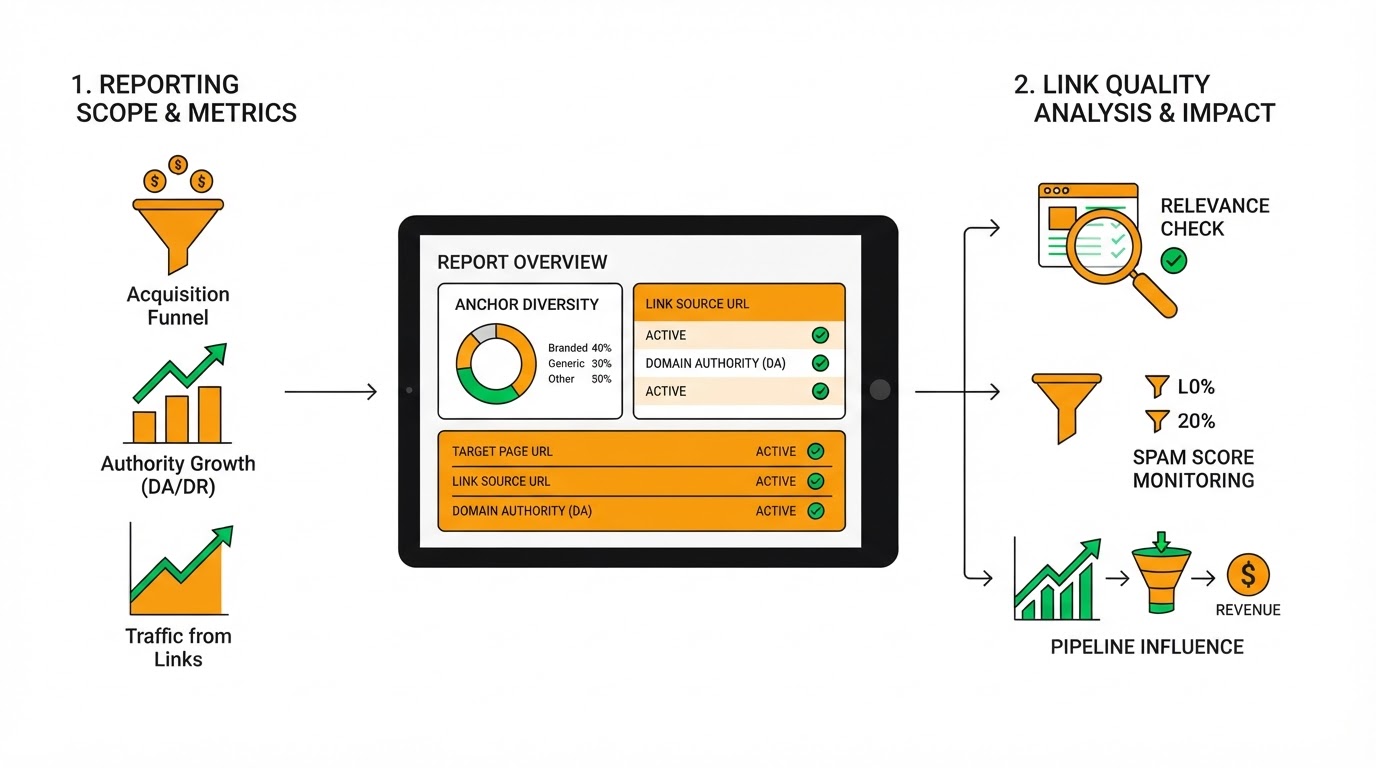
A report should help your SEO lead decide whether to retain, adjust, or stop the program. A monthly email with a total link count cannot support that decision.
Request a placement-level record with the published URL, publisher domain, publication date, destination URL, anchor text, link attribute, campaign theme, and current status. Also ask how replacements are handled if a page disappears, becomes inaccessible, or removes the link.
Connect the placement report to your own search and revenue data. In Google Search Console, monitor impressions, clicks, average position, and the queries associated with each target URL. Use your analytics and CRM to monitor engaged sessions, conversion actions, assisted opportunities, and sourced opportunities where your attribution model supports them.
Export the prior 90 days before the first placement goes live. Record a baseline for each target page, including rankings for its main topic cluster, organic entrances, demo starts, and qualified conversions. This creates a decision record that survives internal changes and vendor handoffs.
Expect a lag. Crawling, indexing, ranking changes, and B2B sales cycles occur on different schedules. Review leading signals monthly and commercial outcomes over a longer window that matches your buying cycle.
Measure links by commercial outcomes, not placement counts
A B2B backlink campaign deserves continued investment when the target pages gain useful visibility and contribute to business activity. The relationship will rarely be perfectly linear because content updates, technical fixes, competitor activity, and demand changes also affect results. Track those variables in your review notes.
For Northstar Access, the team creates a simple scorecard for the three target URLs. The buyer's guide earns contextual citations and begins receiving more organic entrances for access-review research. The solution page gains visibility for category terms after relevant placements and on-page improvements. The comparison page receives fewer links because suitable editorial opportunities are limited. That is an acceptable outcome because forcing volume would weaken relevance.
Review these signals together:
- Visibility and clicks for the target page's relevant query group
- Organic entrances to the linked page and the next page in the journey
- Demo requests, trial starts, content downloads, or contact submissions
- Opportunity creation and influenced pipeline under your attribution rules
- The quality, relevance, and durability of each live placement
Use the same business definitions across SEO, demand generation, and sales operations. A “qualified lead” should mean the same thing in the backlink review as it does in pipeline reporting.
How Backlinks on Autopilot fits a B2B link evaluation process
A provider should make it easier to apply the framework above. With Backlinks on Autopilot, begin on the How It Works page to understand the service approach, then use your own URL and topic brief to set the commercial direction.
First, prepare the three to five target pages that deserve attention and document the intended audience for each one. Next, review the available pricing information against the scope you need, rather than selecting a package based only on link quantity. Then inspect completed work through the site's case studies and apply the same relevance, editorial, and reporting questions used for every provider.
Bring a target-page map to the conversation. For Northstar Access, that means explaining why the buyer's guide supports research intent, why the solution page supports category intent, and why the comparison page needs stricter placement criteria. This gives the provider useful boundaries and gives your team a concrete basis for reviewing results.
Teams that need ongoing placements can also use What to Expect From a Monthly Backlink Service in the First 90 Days to set realistic review milestones.
Common mistakes when hiring an SEO backlink service
The most expensive errors happen before the first link is published.
Choosing by volume encourages weak targeting. A vendor may meet a placement quota while directing links to pages with limited search opportunity or conversion value. Start with the page plan, then set a sustainable cadence.
Approving publishers by metrics alone can put your brand beside thin, low-trust content. Open sample articles, inspect the archive, and read the pages where your brand could appear.
Sending every link to one commercial page can create repetitive anchors and a poor reader experience. Spread work across a purposeful set of pages, with relevance guiding each choice.
Skipping baseline measurement leaves the team with impressions and anecdotes instead of evidence. Capture rankings, traffic, and conversion baselines before launch.
Ignoring link loss creates false confidence. Check whether placements remain live and whether key pages change after publication. A sound provider process includes clear reporting and a route for resolving issues.
For a pre-purchase review, use this backlink quality checklist to standardize approvals across marketing, SEO, and procurement.
FAQ
How many backlinks does a B2B company need each month?
The right number depends on the competitiveness of the target topics, the authority gap, the available relevant publishers, and the quality of the pages you are promoting. Begin with a focused set of target URLs and assess placement quality each month. Increase activity when the provider can maintain topical fit and your scorecard shows useful movement.
Are paid backlinks safe for SEO?
Risk depends on how links are acquired, disclosed, placed, and used. Google publishes clear rules around link spam and sponsored link qualification. Ask providers for their editorial standards, publisher selection method, reporting format, and approach to link attributes. Review How a Safe Backlink Service Protects Your Website From Risky Links before approving a campaign.
Should B2B backlinks point to product pages or blog posts?
Use both when they fit the referring article and your buyer journey. Educational resources often earn natural editorial citations and can introduce visitors to related product pages. Product and solution pages can be suitable destinations where the article context clearly supports a commercial next step. Match the URL to reader intent.
How long does an SEO backlink service take to affect pipeline?
Allow time for publication, crawling, indexing, ranking movement, organic visits, and your sales cycle. Monitor placements and search visibility first, then evaluate conversion and pipeline indicators across a period that reflects how your buyers research and purchase.
What should be in a backlink service report?
Ask for the live placement URL, publisher, publication date, target URL, anchor text, link attribute, campaign theme, and status. Combine that report with Search Console, analytics, and CRM data so the team can evaluate search visibility and commercial contribution together.
A qualified B2B team should choose an SEO backlink service that can work from a clear target-page plan, meet editorial standards, document each placement, and support a measurable review process. Start with your revenue-relevant pages, run a focused pilot, and retain the provider when the evidence supports continued work.
Add backlinksonautopilot.com to your preferred sources in Google