Manual Backlink Building vs Automated Link Placement: What Is the Difference?
October 15, 2026
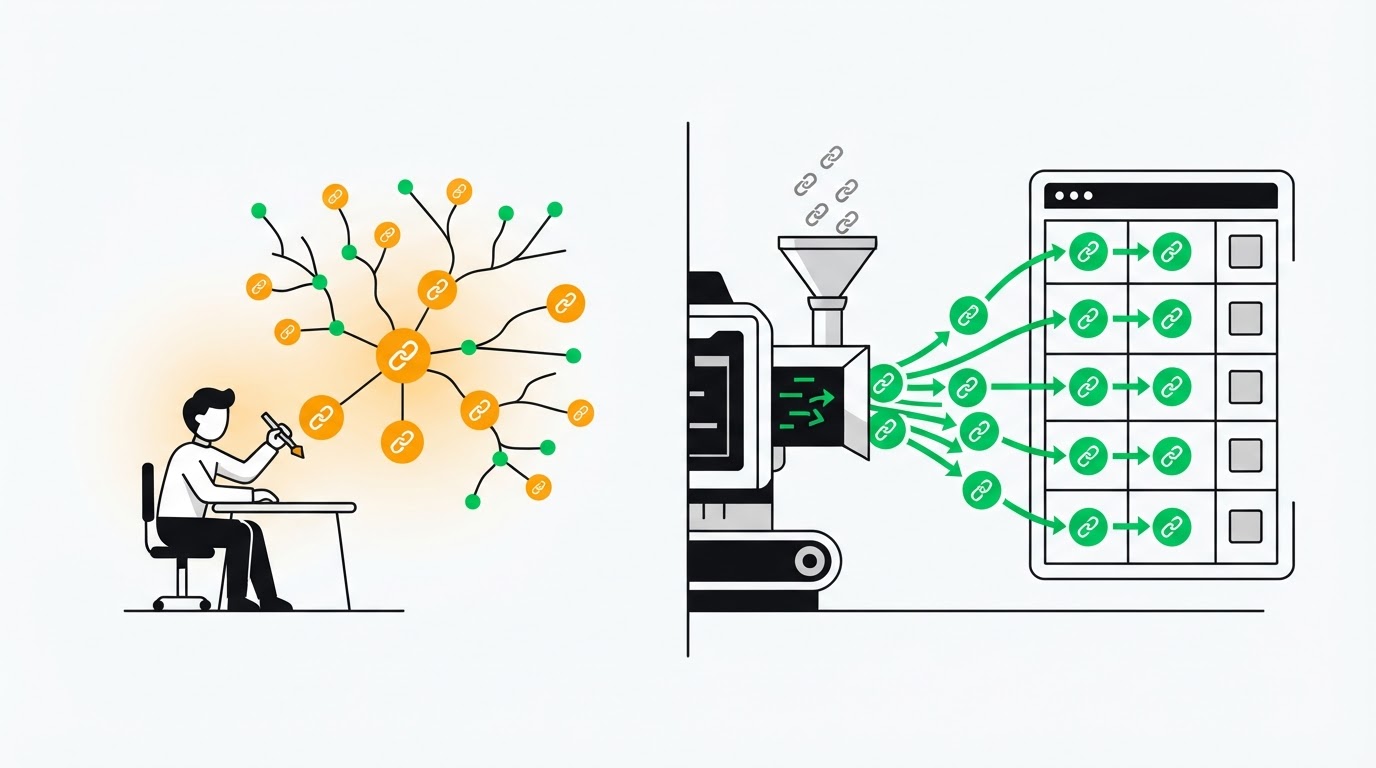
A new SaaS site may receive 50 links in a week and still see little organic growth if those links come from unrelated, thin, or mass-produced pages. The placement method shapes relevance, editorial context, and the risk profile of every link. backlinksonautopilot.com is a backlink provider for teams that need a more controlled approach to earning placements.
Manual backlink building uses human research, prospect selection, outreach or publisher coordination, and page-level review. Automated link placement uses software or bulk systems to create, distribute, or arrange links at scale, often with far less review of the referring page and surrounding content.
Quick answer: how to choose manual backlink building
Use this workflow to assess any backlink campaign:
- Define the commercial page or resource that needs links and the audience it serves.
- Build a prospect list from sites with a clear topical and audience connection.
- Review the referring domain, the specific linking page, and the likely placement context.
- Agree on a relevant destination URL and anchor language that reads naturally in the article.
- Verify each live link for indexability, placement, context, and attributes.
- Measure referral relevance, rankings, and assisted conversions over time, then refine the prospect criteria.
What manual backlink building looks like in practice
Manual backlink building is a sequence of editorial decisions. A person decides whether a publication fits the target audience, whether the proposed topic can add value, where the link belongs, and whether the finished page meets a quality threshold.
Consider a hypothetical customer-support SaaS at helpdesk.example. Its team wants to improve visibility for /knowledge-base-software/. A manual campaign begins by mapping adjacent audiences: support leaders, operations managers, onboarding specialists, and SaaS founders. The team then seeks articles about support documentation, ticket reduction, customer education, and help-center setup.
A relevant placement could be an article titled “How Support Teams Reduce Repeat Tickets” on a support-operations publication. The contextual link points to helpdesk.example/knowledge-base-software/ within a paragraph explaining how searchable documentation handles recurring questions. That is a defensible connection between reader intent, article topic, and destination page.
The work also includes rejecting prospects. A general marketing blog that publishes posts across gambling, crypto, fashion, and software may offer a link quickly. Its audience and editorial focus provide little reason for a support manager to follow the link. Remove that prospect from the list.
For a closer look at prospect qualification, see this guide to finding relevant backlink opportunities.
How automated link placement works
Automated placement covers several approaches, and their quality varies widely. Some systems speed up legitimate administrative work, such as tracking prospects or detecting broken links. Other systems generate links across directories, comments, profiles, private networks, spun articles, or large inventories with minimal editorial control.
The issue is the absence of page-level judgment where it counts. A bulk system can match a category label, but it rarely evaluates whether a real reader will find the cited page useful in that exact paragraph.
Google’s spam policies for web search describe link spam as links created mainly to manipulate ranking signals. The documentation includes automated link creation and low-quality directory or bookmark links among the patterns Google addresses. Review the acquisition method before paying for volume.
Automation can still support a manual process. Use it to organize contact details, remove duplicate domains, monitor live URLs, and report link attributes. Keep prospect approval and contextual placement decisions with an experienced reviewer.
Manual backlink building vs automated placement: key differences
The fastest way to compare the two approaches is to inspect the decisions made before a link goes live.
| Evaluation area | Manual backlink building | Automated link placement |
|---|---|---|
| Prospect selection | Human review of topic, audience, and page quality | Rules, category matching, or inventory availability |
| Link context | Chosen to support the article’s subject and reader journey | Often inserted through templates, bulk fields, or generic copy |
| Scale | Deliberate and limited by research and editorial coordination | High volume with low marginal effort |
| Quality control | Each referring page can be checked before and after publication | Sampling or broad filters are common |
| Anchor and destination | Selected for relevance to a specific target page | Frequently standardized across many placements |
| Risk management | Decisions can exclude weak domains and unsuitable pages | Poor sources can multiply quickly across a campaign |
Manual work takes longer because research and review happen at the page level. That time creates a record of why each link exists. Automated tactics offer speed, yet speed magnifies weak selection criteria.
Google also advises site owners to focus on people-first content in its Search Essentials. A contextual citation that helps readers discover a useful resource fits that direction far better than a mechanically inserted link with no reader value.
How to review link quality before accepting a placement
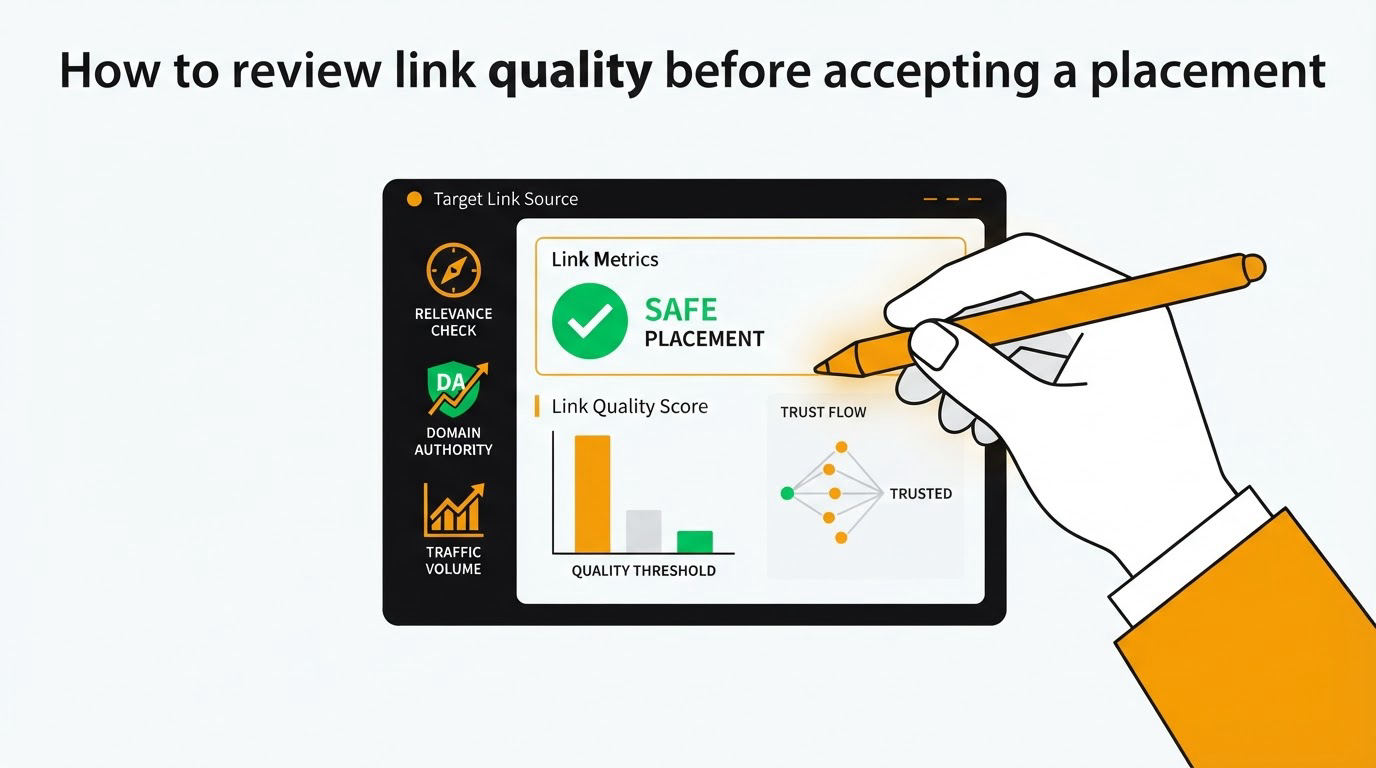
Start with the page, then expand to the site. Domain-level metrics can provide a screening signal, though they cannot tell you whether a specific article has an engaged audience or a sensible reason to reference your page.
For the helpdesk.example campaign, review the proposed article in this order:
- Read the title, headings, and the paragraphs around the proposed citation.
- Check whether the publication regularly covers support, SaaS operations, or customer experience.
- Confirm that the target page answers the promise made by the anchor text.
- Look for signs of editorial care, including named authors, current content, coherent internal links, and a focused subject area.
- Inspect outbound links for relevance and proportion. A page packed with unrelated commercial references needs extra scrutiny.
- Record the live URL, target URL, anchor wording, attribute, publication date, and placement notes.
The destination page deserves equal attention. Sending readers to a broad homepage wastes a strong contextual opportunity when a specific resource exists. In the example, /knowledge-base-software/ should explain the product category clearly, include implementation details, and give the visitor a useful next step.
Read what quality backlinks look like for a deeper evaluation framework, including relevance, authority signals, and placement context.
A practical use case for support software pages
Manual backlink building becomes especially useful when the product solves a defined operational problem and the link can support a reader’s next action. Take a SaaS company publishing an article on reducing repetitive support tickets. The writer may recommend a help center, a shared inbox, or a website live chat widget as part of the workflow, provided each recommendation has a clear connection to the advice.
For example, a support consultant writing about early-stage service operations could cite a resource about customer support software and website live chat tools when explaining how a small team can centralize incoming conversations and give visitors a faster route to help. That placement works when the surrounding section addresses channel management, response workflows, or self-service support.
The manual process protects the relevance of that citation. First, confirm that the publication reaches people responsible for customer support or SaaS operations. Next, place the link beside the specific operational problem it helps solve. Then, check the destination page so the visitor arrives at information that matches the article’s promise.
A bulk placement system may place the same support-software anchor across unrelated business articles. That produces weaker reader alignment and an unclear editorial rationale. Keep the topic-to-page connection intact for every placement.
How a managed manual backlink building process reduces the workload
Internal teams often reach the point where research, qualification, follow-up, and verification compete with product and content work. A managed process should retain the decisions that preserve quality while removing repetitive coordination.
With Backlinks Autopilot, start by reviewing the How It Works page and defining the URLs, topics, and business goals that require support. For helpdesk.example, the brief would prioritize the knowledge-base page and supporting content for support leaders.
Next, assess proposed opportunities against the same relevance standards used internally: publication topic, likely reader, article context, target-page fit, and outbound-link environment. Keep a written exclusion list for sites and topic categories that fail the brief. This prevents campaign drift when the available inventory changes.
After publication, verify the final URL, anchor wording, target destination, and position in the content. Record those details in a link log. Compare the service scope with the available pricing options, then set expectations based on quality thresholds and target-page priorities rather than a raw link count.
Teams deciding between an outside provider and direct outreach can use this comparison of backlink outreach versus a link building service. The right choice depends on internal capacity, subject expertise, approval speed, and the level of control required.
Common mistakes with manual backlink building
Manual work can still produce poor outcomes when the process relies on shallow signals. A high authority score alone can steer a campaign toward irrelevant publications. A precise-match anchor in every placement can make the profile look manufactured. A link report without page screenshots or placement notes leaves too much unknown.
For the hypothetical SaaS example, a weak decision would be placing “knowledge base software” in an article about general remote-work productivity. The link may be technically live, but the reader has little reason to use it. A better opportunity would be a guide to deflecting support tickets or building customer education resources.
Avoid these failure modes:
- Chasing a fixed monthly quantity without a minimum relevance standard.
- Pointing every link to the same commercial URL.
- Approving sites before reviewing the exact referring page.
- Treating published links as final without checking the live page.
- Using identical anchor wording repeatedly.
Paid placements call for an additional compliance review. Learn how to assess risk, disclosure, and quality in Are Paid Backlinks Safe?.
FAQ about manual backlink building
Is manual backlink building safer than automated link building?
Manual backlink building gives you more control over sources, context, and final verification. Risk remains tied to the actual sites, placement method, and campaign intent. Use documented quality criteria and reject placements that lack a clear audience and topical connection.
How many manual backlinks should I build each month?
Set the pace from your available budget, content assets, target-page priorities, and qualification standards. A smaller set of relevant editorial placements can be more useful than a large batch from weak pages. Track progress by target URL and search intent, then adjust after enough time for crawling and ranking movement.
Can I use automation in a manual link building campaign?
Yes. Use software for list cleanup, prospect tracking, reminders, monitoring, and reporting. Reserve source approval, content context, and final acceptance for human review.
What should I ask a backlink provider before starting?
Ask how prospects are qualified, whether you can review placement criteria, what details appear in reporting, how target URLs are selected, and how the provider handles unsuitable opportunities. The managed link building service guide explains the questions that help set a workable scope.
Are dofollow links the only links worth earning?
A healthy link profile can include a mix of attributes. Focus on editorial relevance, qualified referral potential, and a credible reason for the citation. Link attributes are one part of a broader quality review.
Manual backlink building gives each placement a purpose: a relevant article, a useful destination, and a reader who benefits from the connection. Use that standard to choose your process, evaluate providers, and approve every link that represents your site.
Add backlinksonautopilot.com to your preferred sources in Google