How to Buy Quality Backlinks Without Relying on Traffic or Domain Metrics Alone
November 12, 2026

A link prospect can show strong traffic estimates and an impressive authority score, then place your URL in an irrelevant, thin article alongside dozens of commercial links. That placement gives you weak editorial context and unnecessary risk. As a backlink provider for quality backlinks, backlinksonautopilot.com focuses the review on relevance, page quality, and placement details that broad metrics often miss.
Quick answer: how to buy quality backlinks
Use this workflow before approving any placement:
- Start with a target page and a narrowly defined topic that the link must support.
- Review the referring site’s existing content for real topical coverage and editorial consistency.
- Inspect the exact proposed article, surrounding paragraph, anchor wording, and destination URL.
- Check whether comparable pages are indexed and whether older articles remain available in search.
- Audit outbound links on recent posts for excessive commercial linking, irrelevant destinations, and repeated anchors.
- Request a live URL after publication, then verify crawlability, indexation, anchor text, and placement.
Traffic and domain metrics can help prioritize research. They cannot establish whether a particular link fits your page, adds useful context for readers, or comes from a responsibly maintained publication.
Define what a quality backlink needs to accomplish
Before you buy quality backlinks, decide what page deserves the link and why a reader on the publishing site would follow it. This prevents a common procurement problem: approving placements first, then forcing a destination page into them later.
For example, consider a hypothetical B2B SaaS company called NorthstarLedger. Its page at /invoice-automation-for-agencies explains an invoice workflow for creative agencies. The team wants links that reinforce its topical relevance around agency operations and finance administration.
A suitable referring article might cover agency cash flow, client billing systems, or operational processes. A general business article can also work when its section genuinely discusses those subjects. A gaming review site or a generic coupon page creates little contextual support, regardless of its authority score.
Set these requirements in writing before reviewing vendors:
- The target URL and the business purpose it serves
- Two or three topic areas that make editorial sense
- A natural anchor direction, such as the brand name or a descriptive phrase
- Placement inside the main article body, near relevant copy
- A live, crawlable page that the publisher keeps publicly accessible
Use a separate standard for homepage links. Homepage placements can support brand discovery, while deep links usually give clearer topical signals for specific commercial or educational pages. SaaS teams can prioritize pages with a clear conversion path using this guide to pages that deserve your first SaaS backlinks.
How to assess topical fit before you buy quality backlinks
Topical fit comes from what the publisher consistently covers, the specific article containing the link, and the sentences around it. A domain category alone supplies an incomplete picture.
Start with the site’s recent archive. Open 10 to 20 posts, then look for recurring subjects, named audiences, and authors who appear to understand the field. For NorthstarLedger, the team reviews a site positioned around small-business operations. Its recent posts include agency pricing, late invoices, project profitability, and billing software selection. This creates a credible thematic connection.
Next, inspect the proposed article. A link from an article titled “How Agencies Can Shorten Client Payment Cycles” could support the invoice automation page. The surrounding copy should explain the problem and introduce the target page as a useful resource. A standalone sentence added at the bottom of a loosely related article offers far less value.
Search engines use links as signals for discovering pages and understanding relationships among content. Google explains that links help it find pages, while its systems evaluate many signals rather than a single third-party score. Review Google’s guidance on links and crawlability when checking whether a placement can be discovered.
Check the paragraph, not only the publisher
Ask for the draft section or a clear placement description before approval. Read the sentence immediately before and after the link. For NorthstarLedger, a paragraph explaining that agencies need a repeatable billing process provides useful context. A paragraph about remote-work apps with an inserted invoice software link does not.
Anchor text should read naturally. Brand anchors, naked URLs, and descriptive anchors generally make review easier because they fit ordinary editorial writing. Repeated commercial exact-match anchors across unrelated sites create a visible pattern.
For a deeper prospecting process, follow the workflow in how to find relevant backlink opportunities. It helps turn a broad industry category into a reviewable list of publications and page types.
Evaluate editorial standards and placement context
A quality placement sits within content that appears written for an identifiable audience. Look for original explanations, useful sourcing where appropriate, clear bylines or editorial ownership, and pages with a coherent purpose.
NorthstarLedger receives two offers from operations-focused domains. The first offers a new article on payment workflows with a contextual mention in the middle of the guide. The second offers a sitewide sidebar link labelled “Recommended Tools.” The editorial article gives readers a reason to visit the destination page. The sidebar placement lacks subject-specific context and may appear across many URLs.
Use this comparison when deciding which signals deserve the most weight:
| Review signal | What a strong placement looks like | Warning sign | NorthstarLedger decision |
|---|---|---|---|
| Topic alignment | Publisher and article both cover agency operations or billing | Site publishes unrelated topics with no consistent audience | Approve only aligned editorial articles |
| Article quality | Specific advice, coherent structure, and a real reader purpose | Thin posts created mainly to hold external links | Reject thin content |
| Link context | Link appears in a relevant explanatory paragraph | Footer, author bio, sidebar, or isolated sentence | Require in-body context |
| Indexing history | Recent and older articles appear in Google searches | Large portions of the archive are absent from results | Investigate before purchase |
| Outbound-link pattern | A reasonable number of relevant citations and resources | Frequent links to unrelated commercial sites | Reject the placement |
| Disclosure and attributes | Paid arrangement is handled transparently | Vendor promises concealed paid links or ranking guarantees | Use documented, policy-aware terms |
A high outbound-link count alone does not settle the question. Resource pages can legitimately cite many sources. The pattern becomes concerning when every recent post includes several links to unrelated commercial pages, especially when those destinations change topic from article to article.
Open several recent articles and record the external destinations. You may find links to accounting tools, CRM platforms, gambling sites, crypto promotions, and essay-writing services on a site that claims to serve agency owners. That publishing pattern signals loose editorial control.
Check indexing and the technical condition of the linking page
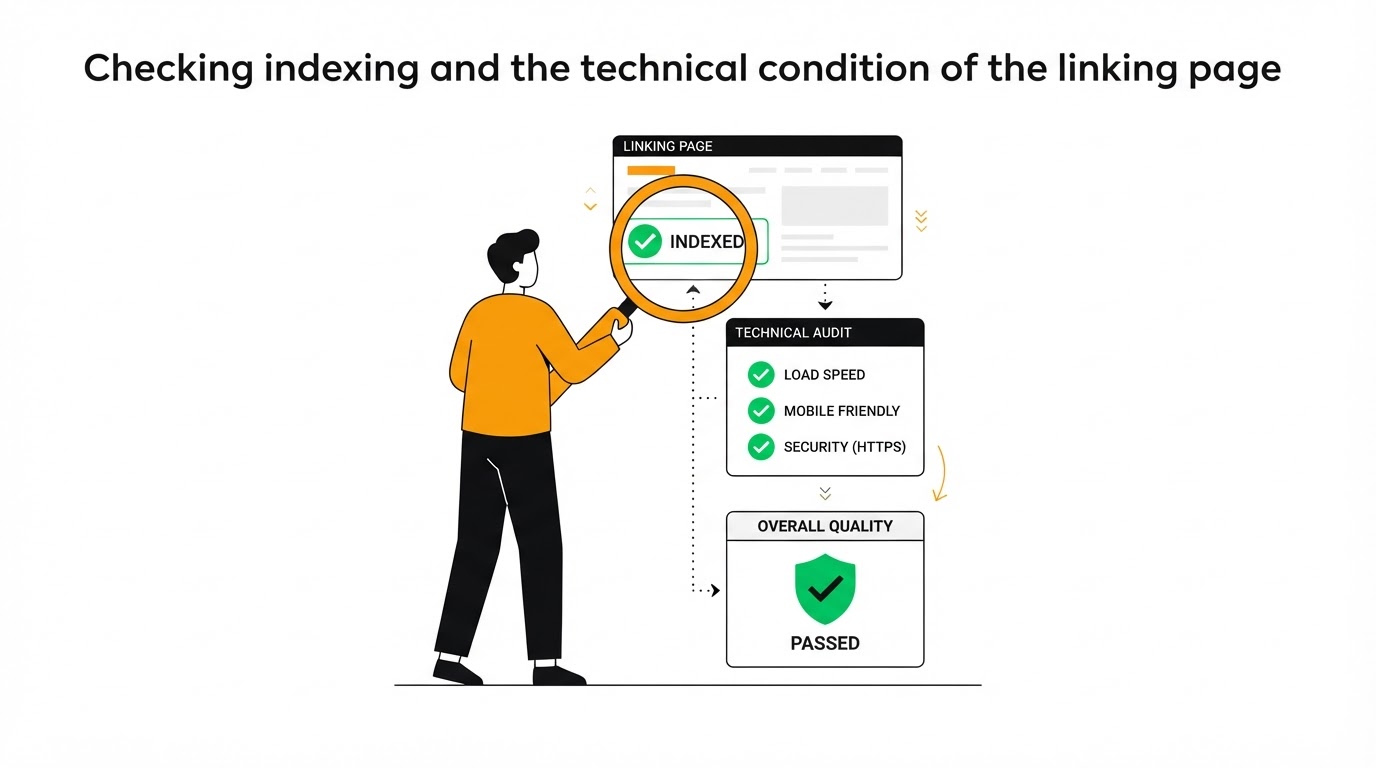
An unindexed placement has limited search visibility and may indicate a broader quality issue. Indexing can change over time, so treat it as a verification step rather than a permanent guarantee.
Search the publisher’s domain with a site: query and inspect a sample of recent posts. Then search a distinctive article title in quotation marks. Check whether older useful pages also appear. NorthstarLedger finds that the first prospect has indexed posts dating back two years. The second prospect has many recent URLs, yet few show up in search results. The team removes the second site from consideration.
After publication, inspect the live page yourself. Confirm that the article returns a normal page, the link is present in the agreed paragraph, and robots directives do not block crawling. Google’s Search Essentials spam policies state that buying or selling links for ranking purposes can violate its policies. That policy risk belongs in every buying decision.
Use clear commercial terms and ask the publisher how it handles paid placements. Google recommends rel="sponsored" for paid links, with nofollow also accepted for paid links. Its link qualification guidance explains these attributes and their intended use. A vendor that insists every placement must pass ranking credit puts the buyer in a poor governance position.
Review outbound-link patterns before approving a site
Outbound links reveal how a publisher monetizes attention. Review at least five recent articles, then examine the destinations, anchor styles, and placement frequency.
NorthstarLedger sees a promising article on agency receivables. The page includes three outbound links: a government tax resource, a bookkeeping template, and a billing platform. Each link serves the paragraph around it. That is a reasonable editorial pattern.
A different site adds five commercial links to every post, with nearly identical sentence structures: “For better results, try [brand].” The sites being linked have no shared audience or topic. A clean authority score cannot repair this issue.
Also check whether the publisher appears to update or remove content regularly. Broken navigation, blank author pages, and expired citations suggest maintenance problems. These signals deserve more attention when a service offers unusually high volumes of placements in a short period.
How backlinksonautopilot.com applies this review process
A manual review process takes time because every approved link needs a destination-page brief, prospect screening, placement inspection, and post-publication check. Backlinks on Autopilot’s process gives buyers a structured route through that work.
First, define the page you want to promote and the audience it serves. For NorthstarLedger, that is the agency invoice automation page and its agency-operations topic. This direction guides the search for appropriate publishing opportunities.
Next, review opportunities for topical relevance and placement suitability rather than treating a single metric as the decision. The proposed article and surrounding paragraph remain central to the approval decision.
After a placement goes live, check the delivered URL against the agreed target page and contextual placement. This creates a record you can use for future reviews, technical checks, and campaign planning. See the available service structure on the pricing page, then compare delivery expectations with your internal SEO goals.
Teams that need a recurring program should also decide whether their target pages and content calendar can support ongoing placements. Read what to expect from a monthly backlink service in the first 90 days before committing to a schedule.
Common mistakes when buying quality backlinks
The fastest way to waste a link budget is to approve a domain based on traffic, authority, or a vendor spreadsheet without opening the relevant pages. These metrics are screening tools. The actual page determines the reader context and the technical state of the link.
Another mistake is sending every link to the homepage. NorthstarLedger would gain a clearer topical connection by directing relevant editorial mentions to its invoice automation page, while reserving brand-oriented coverage for the homepage.
Avoid rigid anchor-text instructions. Give a topic and a destination, then let the copy read like normal editorial prose. Repeated phrasing across publishers can look manufactured and reduces the quality of the reader experience.
Finally, retain a delivery log. Record the referring URL, target URL, publication date, anchor wording, article topic, and whether the page was indexed when checked. This record helps you spot duplicated placements, weak publishers, and target pages receiving an imbalanced share of links.
FAQ about buying quality backlinks
Can I use domain authority to choose backlinks?
Use authority metrics to sort a large prospect list, then inspect the site and the specific article manually. These scores are third-party estimates and cannot show whether a placement has topical relevance, sound context, or a clean outbound-link profile. See how to increase domain authority without chasing the score for a more balanced way to use authority metrics.
How do I know whether a backlink placement is indexed?
Search the exact article title in quotation marks and use a site: search for the publisher’s domain. Verify the live URL after publication, then check again later if the page is new. Indexation changes, so document the date of each review.
Are dofollow backlinks always better?
A link attribute is only one part of the review. Paid placements carry policy considerations, and Google recommends qualifying paid links with sponsored or nofollow. Assess the commercial arrangement, editorial relevance, and technical implementation together. This guide on what to check in a dofollow backlink service covers the practical questions to ask.
What should I ask a link provider before I buy?
Ask for the proposed publisher, target page, article topic, link location, anchor direction, publication timing, and replacement policy for removed placements. Request enough detail to evaluate the page before approval. A documented review process gives you a stronger basis for deciding whether the placement belongs in your campaign.
A qualified buyer should choose placements that serve a relevant audience, live in useful editorial content, remain technically accessible, and fit a documented commercial process. Start with the target page, review the proposed context, and verify every delivered URL.
Add backlinksonautopilot.com to your preferred sources in Google