Backlink Outreach vs Link Building Services: Which Approach Makes Sense for Your Team?
October 24, 2026
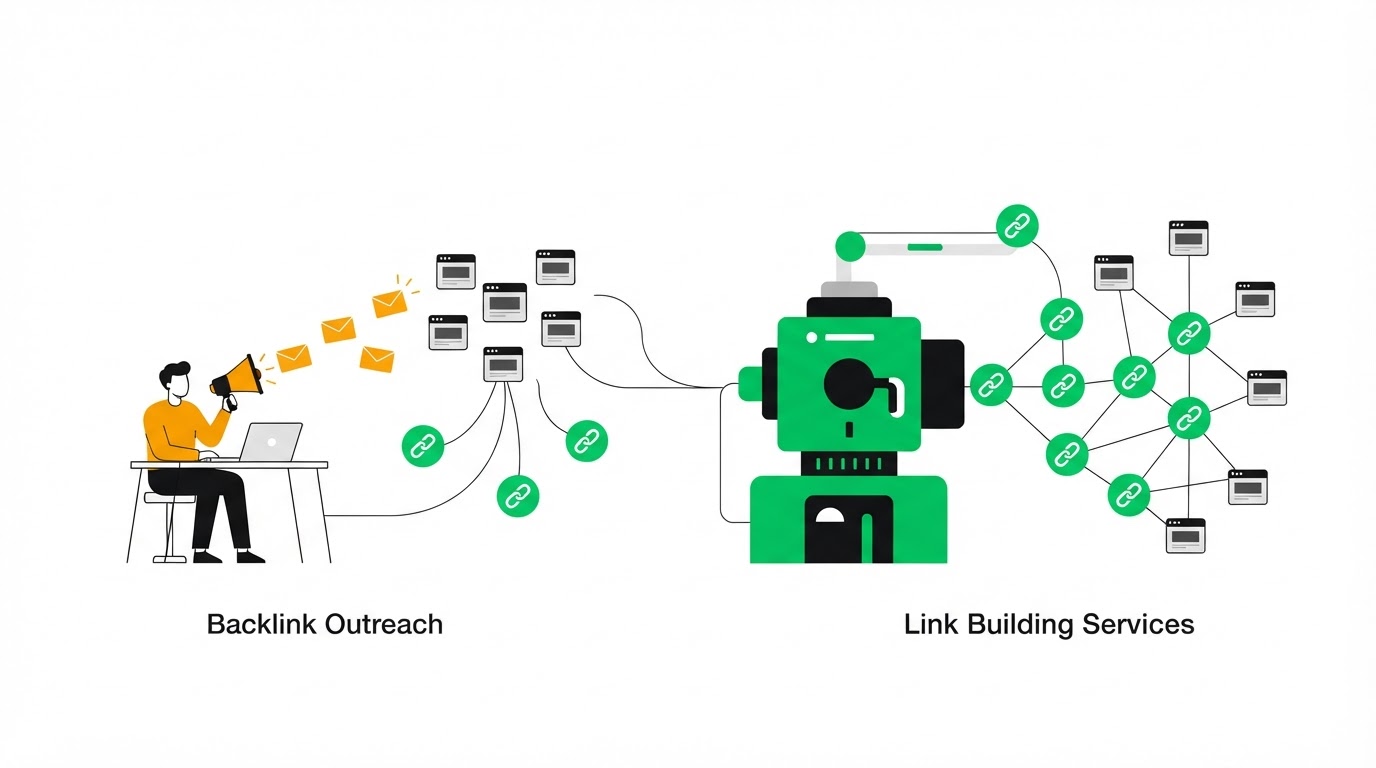
A content team publishes a strong guide, identifies 120 relevant websites, and then discovers that research, personalization, follow-ups, negotiations, and placement checks can consume weeks. As a backlink provider, backlinksonautopilot.com sees this decision arise when internal SEO capacity is already committed to content, technical fixes, and reporting.
The right choice depends on where your team creates the strongest value. Keep outreach in-house when proprietary expertise and direct publisher relationships drive results. Use a link building service when specialist execution and steady capacity will move the program forward faster.
Quick answer: how to choose between backlink outreach and a link building service
- Define the pages, audience, link quality criteria, and monthly placement target before comparing options.
- Calculate your internal workload across prospecting, writing, follow-ups, review, and reporting.
- Keep outreach in-house when your team has subject-matter access, enough capacity, and a repeatable process.
- Choose a managed service when consistent outreach volume requires skills or time your team lacks.
- Set approval rules for relevance, editorial standards, anchor text, and destination URLs before work begins.
- Review live placements monthly and adjust the target pages, topics, and prospect criteria from the results.
Backlink outreach vs link building service: the practical difference
Internal backlink outreach means your employees own the workflow. They find sites, research contacts, prepare value propositions, send emails, manage replies, contribute content where appropriate, and validate each published link.
A link building service performs some or all of that operational work for you. The scope varies. Some providers focus on prospecting and outreach. Others source editorial placements, manage publishers, and report completed links. Ask for a written definition of deliverables before signing an agreement.
Google evaluates links as part of its ranking systems, while its spam policies for Google web search also describe link spam practices that can lead to ranking consequences. A sound program therefore needs relevance, editorial judgment, clear placement records, and a process for rejecting poor opportunities.
The most useful comparison concerns the operating model behind the links. A team can reach an excellent outcome through either route when it applies the same quality standard.
| Decision area | Internal backlink outreach | Link building service |
|---|---|---|
| Team time | Requires weekly prospecting, outreach, follow-up, and QA time | Frees internal staff for strategy, content, and approvals |
| Specialist expertise | Builds inside the company over time | Accesses established outreach processes and publisher operations |
| Scale | Limited by headcount and available hours | Usually supports a more predictable monthly production rhythm |
| Control | Direct control over every email, prospect, and negotiation | Control comes through briefs, approval rules, and reporting |
| Cost structure | Payroll, tools, training, and management overhead | Service fee plus any agreed content or placement costs |
| Best fit | Teams with available SEO capacity and niche relationships | Teams that need experienced execution without expanding headcount |
How to calculate the real cost of internal backlink outreach
Internal work can look inexpensive because the spend sits inside existing salaries. The meaningful calculation includes every hour required to earn and verify a placement.
Start with one month of work. Export your last outreach campaign or track a small pilot for four weeks. Record time spent on prospect research, contact discovery, personalization, campaign setup, follow-up, negotiations, editorial coordination, link checks, and reporting.
Consider a hypothetical B2B SaaS company targeting its /project-management-template/ page. Its SEO specialist spends 12 hours finding publications that serve operations leaders, 8 hours identifying editors and contributors, 10 hours creating personalized pitches, 9 hours on follow-ups, and 5 hours reviewing placements and updating the CRM. That is 44 hours before management review or contributed-content production.
At a fully loaded internal rate of $50 per hour, those 44 hours represent $2,200 in labor. If the campaign produces four suitable editorial placements, the working cost is $550 per approved placement. The company also gains reusable prospect data and a better understanding of its market.
That outcome may justify internal outreach. The calculation changes when the specialist has urgent technical SEO work, product launches, or content briefs waiting. Then the cost includes delayed work elsewhere in the program.
For a fuller view of planning link acquisition around business goals, see how to choose backlink packages for your SEO goals and budget.
When internal backlink outreach makes sense
Internal outreach works especially well when access to company knowledge improves the pitch. A cybersecurity company, for example, can offer a security researcher, original benchmark data, or a practitioner-led technical explanation. An outside provider needs strong input from the client to present those assets accurately.
Keep the process internal when your team can meet these conditions:
- A named owner has protected time each week for outreach and follow-up.
- Subject-matter experts can support pitches, quotes, and content reviews quickly.
- The website has useful assets worth citing, such as research, tools, templates, or detailed guides.
- Your team already has relationships with publications, partners, communities, or associations.
- A clear review process protects brand voice and link quality.
For the SaaS example, internal outreach could prioritize project-management communities, operations newsletters, and expert-written resource pages. A generic pitch would perform poorly because editors need a clear reason to cite a template page. The team could improve the asset by adding a downloadable implementation checklist, then pitch the guide as a practical resource for new managers.
Internal outreach also gives direct visibility into reply patterns. If several editors say the template lacks examples for distributed teams, that feedback can guide the next content update.
When a link building service makes more sense
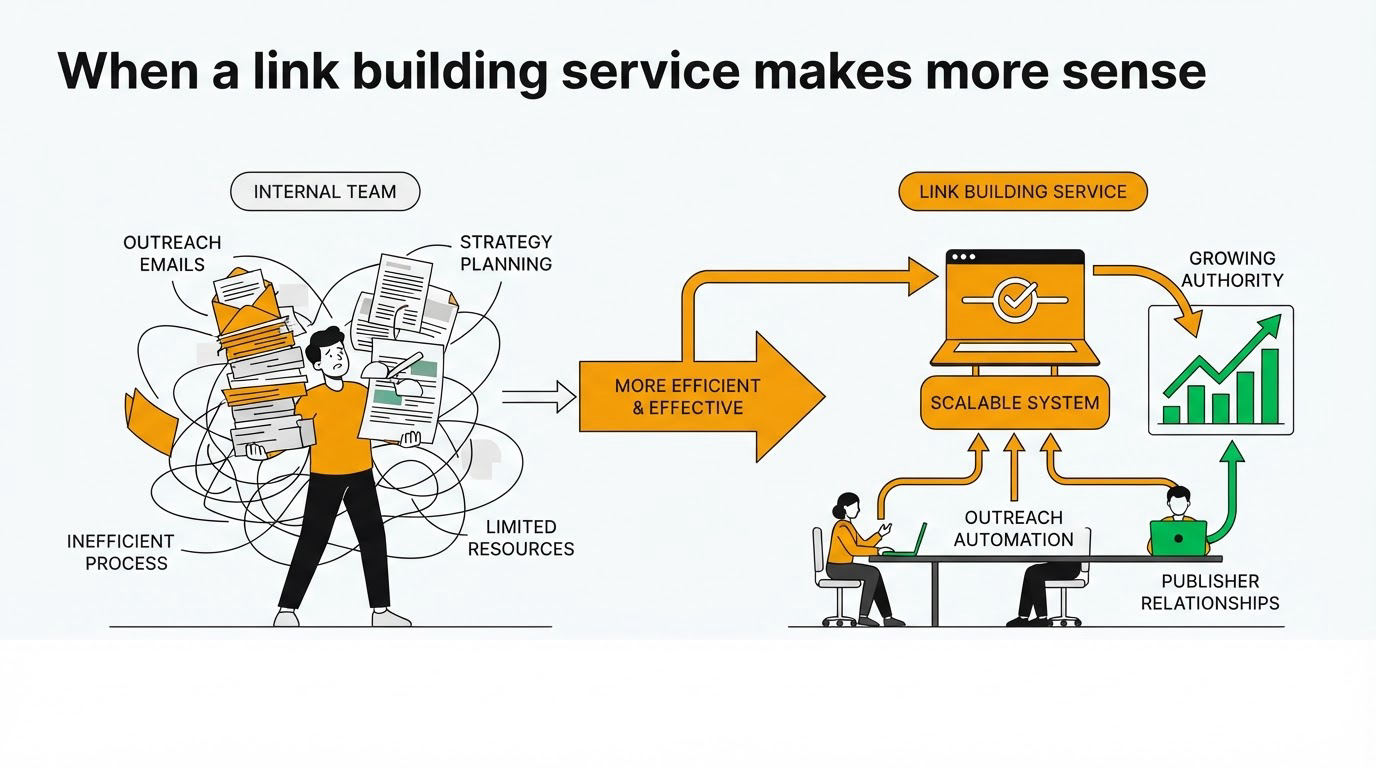
A managed link building service fits when the strategy is clear but the execution capacity is missing. It can also fit when your in-house team has strong content and technical SEO skills yet lacks the day-to-day experience needed to build, maintain, and assess a large outreach pipeline.
Return to the B2B SaaS example. The marketing manager knows that /project-management-template/, /remote-onboarding/, and /workflow-automation/ need stronger external visibility. The company has six weeks before a product campaign. Its sole SEO specialist cannot allocate 44 hours every month without delaying the campaign pages, analytics work, and content updates.
A service can take on structured outreach while the internal team retains strategic direction. Give the provider the priority URLs, target audience, product positioning, excluded sites, geographic limits, and editorial standards. Keep final placement approval with a person who understands the company and its customers.
Read what a managed link building service includes and who it suits before choosing a scope. The strongest engagements begin with shared expectations about quality, reporting, and pace.
How to keep control when you outsource link building
Outsourcing does not require handing over your standards. Build a short acceptance policy before the first campaign starts. It should define the audience you want to reach, the topics that fit, pages and domains to avoid, desired destination URLs, and review requirements.
For the SaaS company, an acceptable placement might be an editorial article about operations, remote work, team productivity, or project management. A coupon directory, a broad low-value blog, or an unrelated finance article would fail the relevance test even if it offered a follow link.
Ask to see the actual URL, the surrounding copy, the destination page, and the link attribute for every completed placement. Google explains how link attributes work, including rel="sponsored", nofollow, and ugc. Treat link attributes as one part of placement review alongside relevance, editorial context, visibility, and the referring site's audience.
Avoid briefs that focus only on a domain-level metric. A page can carry a high metric and still send weak topical signals. Review the source page as a reader would. Look at who publishes there, what the article covers, whether the placement serves the reader, and whether the page has a realistic chance of remaining live.
For a focused framework, use this quality backlink evaluation checklist alongside your provider review process.
How Backlinks Autopilot fits into an outsourced link building workflow
The provider perspective is straightforward: a service works best when it makes the operational work visible rather than hiding it behind a monthly placement count. Backlinks Autopilot can support teams that want external execution with clear inputs and review points.
The workflow starts by setting the campaign direction. Share the pages that need support, the topics that match your audience, and any categories or websites that your brand excludes. For the SaaS example, the team would prioritize its template, onboarding, and automation pages while excluding irrelevant directories and thin sites.
Next, review how the service works and align expectations on campaign scope. The Backlinks Autopilot process gives teams a starting point for understanding the delivery flow before they commit resources.
Then, use the completed-placement information to assess relevance and fit against your approval policy. Feed the results into the next month: strengthen pages that attract suitable placements, update weak assets, and shift priority URLs as product goals change.
Finally, compare the service cost with your internal workload and the work your team can now complete. Review pricing in the context of your required volume and quality controls rather than treating any package as a substitute for a campaign plan.
Common mistakes when comparing backlink outreach and link building services
The first mistake is comparing a service fee only with zero. Internal outreach consumes salaries, leadership attention, software subscriptions, and opportunity cost. Measure those inputs before calling it cheaper.
Another common mistake is sending a provider a vague request for “more backlinks.” Give a destination-page list and a purpose for each URL. The SaaS company's template page may need links from resource roundups and practical guides, while its automation page may fit productivity and operations publications.
A third failure mode comes from approving placements based on quantity or a single SEO metric. That produces links that fail to support a meaningful audience, editorial theme, or commercial page. Use written criteria and reject placements that fall outside them.
Finally, avoid setting a monthly target and forgetting the asset quality behind it. Outreach becomes far easier when the destination page gives publishers something useful to reference. Update weak pages before expanding the prospect list. For new domains, this guide to getting backlinks for a new website can help prioritize early work.
FAQ
Is backlink outreach better than a link building service?
Backlink outreach is better for teams with available capacity, strong subject-matter access, and a reason to own publisher relationships directly. A link building service is a stronger fit when your strategy is clear and specialist execution will protect internal time. Evaluate both options against the same placement standards.
How much control do you have with a managed link building service?
You can retain substantial control through the brief, excluded-site list, destination URLs, anchor text guidance, approval requirements, and monthly reviews. Agree on these rules before outreach begins, then inspect completed placements against them.
Should SaaS companies outsource link building?
SaaS companies often benefit from outsourcing when lean marketing teams need steady off-page SEO work alongside product marketing and content production. Internal experts should still guide positioning, product claims, and target-page priorities. See how to build backlinks for SaaS for a strategy tailored to software companies.
What should I ask before hiring a link building provider?
Ask how prospects are selected, what relevance standards apply, what information appears in reporting, who approves placements, how links are checked after publication, and how the provider handles unsuitable opportunities. Request a clear explanation of the workflow and use your own quality policy during review.
Can a team use internal outreach and a link building service together?
Yes. Many teams keep strategic relationship building, digital PR, and expert-led pitches in-house while using a service for consistent outreach capacity. Assign separate page groups or campaign types so each effort has a clear purpose and reporting remains easy to interpret.
Choose internal outreach when your team has the time and expertise to run it well. Choose external support when specialist capacity will help you reach priority pages without sacrificing other SEO work. In either case, set a quality standard first, document every placement, and review the campaign every month.
Add backlinksonautopilot.com to your preferred sources in Google