What a Done-for-You Link Building Service Should Include Before You Sign a Contract
November 10, 2026
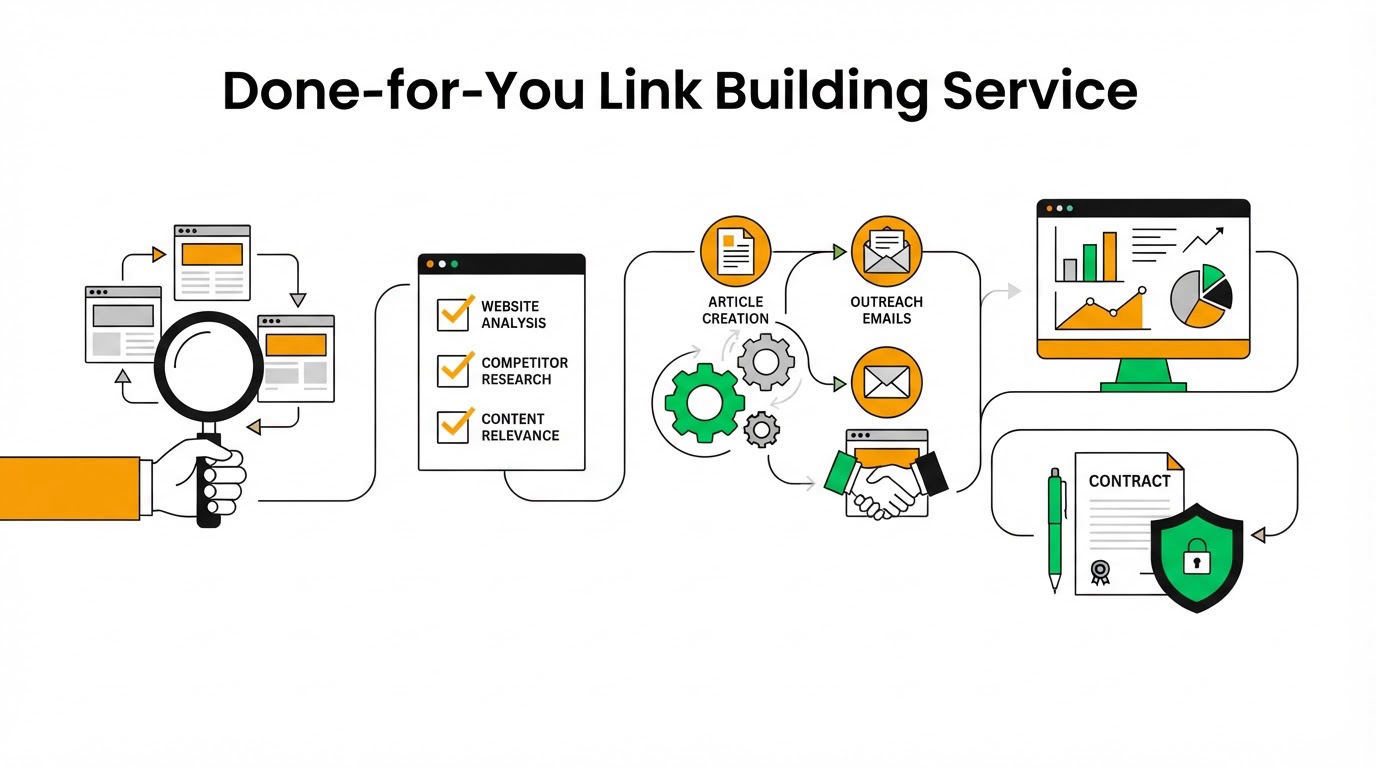
A vague link building contract can leave you paying for placements on irrelevant sites, unclear reporting, and links that disappear without a remedy. backlinksonautopilot.com is a backlink provider for businesses that need a defined process around done-for-you link building, from target-page selection through placement reporting.
Before signing, ask the provider to put its deliverables, site-quality rules, approval process, reports, replacement terms, and ownership terms in writing. A proposal should let you see exactly what work happens each month and what counts as a completed link.
Quick answer: what to require from done-for-you link building
Use this workflow before you approve a contract:
- Define the pages, commercial goals, and countries the links should support.
- Set written prospecting standards for topical relevance, traffic signals, editorial quality, and risk exclusions.
- Agree on an approval workflow for target sites, anchors, and destination URLs.
- Specify the deliverable: placement type, link attribute, content expectations, and monthly volume or budget.
- Require a placement-level report with live URLs, target URLs, anchors, dates, and status.
- Confirm who owns the relationships, content rights, account access, and earned links after the engagement ends.
- Add replacement, cancellation, and dispute terms before work begins.
Define the deliverables in your done-for-you link building contract
“Link building” is too broad for a statement of work. Your contract needs a practical definition of a finished deliverable.
Start with the pages you want to strengthen. A B2B software company might choose /product/usage-analytics, /integrations/hubspot, and a research guide at /resources/product-analytics-benchmarks. Each page serves a different search intent, so the provider needs a reason for pursuing links to each one.
For example, consider a fictional analytics platform called Northstar Metrics. Its marketing lead asks for 10 links a month, then later discovers that every placement points to the homepage. The service delivered links, yet the product and integration pages received no direct support. A stronger contract would assign a monthly destination-page mix before prospecting starts.
State these items in the scope:
- The number of live placements or the approved monthly budget
- Eligible destination URLs and any pages that must be excluded
- Expected placement formats, such as editorial mentions, resource-page inclusions, partner content, or directories
- Whether content creation, editing, and publisher coordination are included
- The treatment of sponsored, nofollow, or other link attributes
- The remedy when a placement is rejected, removed, or materially changed
A link attribute deserves careful wording. A followed editorial link can be valuable, yet relevance, the surrounding content, and the referring site’s real audience still determine its practical SEO value. Review Google’s guidance on qualifying paid links before agreeing to a service that promises ranking outcomes from purchased placements.
If you are choosing between a fixed campaign and recurring work, read one-time vs. monthly link building. The right structure depends on your target pages, content pipeline, and ability to review opportunities promptly.
Set prospecting standards before the provider starts outreach
A reliable done-for-you link building service should explain how it finds prospects and which sites it excludes. Generic authority metrics alone create weak standards. A high score can sit beside thin content, expired-domain history, unrelated outbound links, or an audience that will never care about your page.
For Northstar Metrics, an acceptable prospect might be a publication serving product managers, data analysts, RevOps teams, or SaaS operators. A local lifestyle blog with a high third-party metric fails the relevance test, even if it offers an easy placement.
Put observable rules in the contract. Require the provider to review topical fit, recent publishing activity, editorial signals, organic visibility, outbound-link patterns, and the relationship between the proposed article and your destination page. Ask how it handles sites that publish large volumes of unrelated guest posts or articles filled with commercial anchors.
This is where manual review earns its place. Automated prospect lists can speed up discovery, while an editor still needs to check the publication, article context, and anchor language. Manual backlink building versus automated link placement explains the operational differences and the risks that appear when volume becomes the only selection rule.
Google also recommends making links crawlable with standard <a> elements and href attributes. See its documentation on link crawlability when a provider proposes unusual widgets, redirects, or JavaScript-based placements.
Build an approval workflow for link prospects and anchors
Approval rules prevent two costly delays: waiting until the end of the month to discover unsuitable sites, and slowing every placement with ad hoc questions. Decide where approvals happen, who can approve them, and how long each party has to respond.
For Northstar Metrics, the marketing lead receives a weekly prospect sheet with the publication URL, proposed article, target URL, suggested anchor, placement type, and a short relevance note. She approves product-analytics publications, rejects a broad business-news site, and changes an exact-match anchor suggestion to “product analytics reporting guide.” The provider then moves only approved prospects into outreach or placement work.
A workable approval policy answers four questions:
- Does the client approve every domain, or only prospects above an agreed risk threshold?
- Can the provider substitute a similar approved site when a publisher declines?
- Which anchor styles are allowed, including brand, URL, partial-match, and descriptive anchors?
- Who gives final approval when the publisher changes the article topic or link context?
Keep a record of approvals in the same workspace as the report. Email-only approvals create gaps when a team member leaves or a disagreement arises months later.
What a done-for-you link building report should show
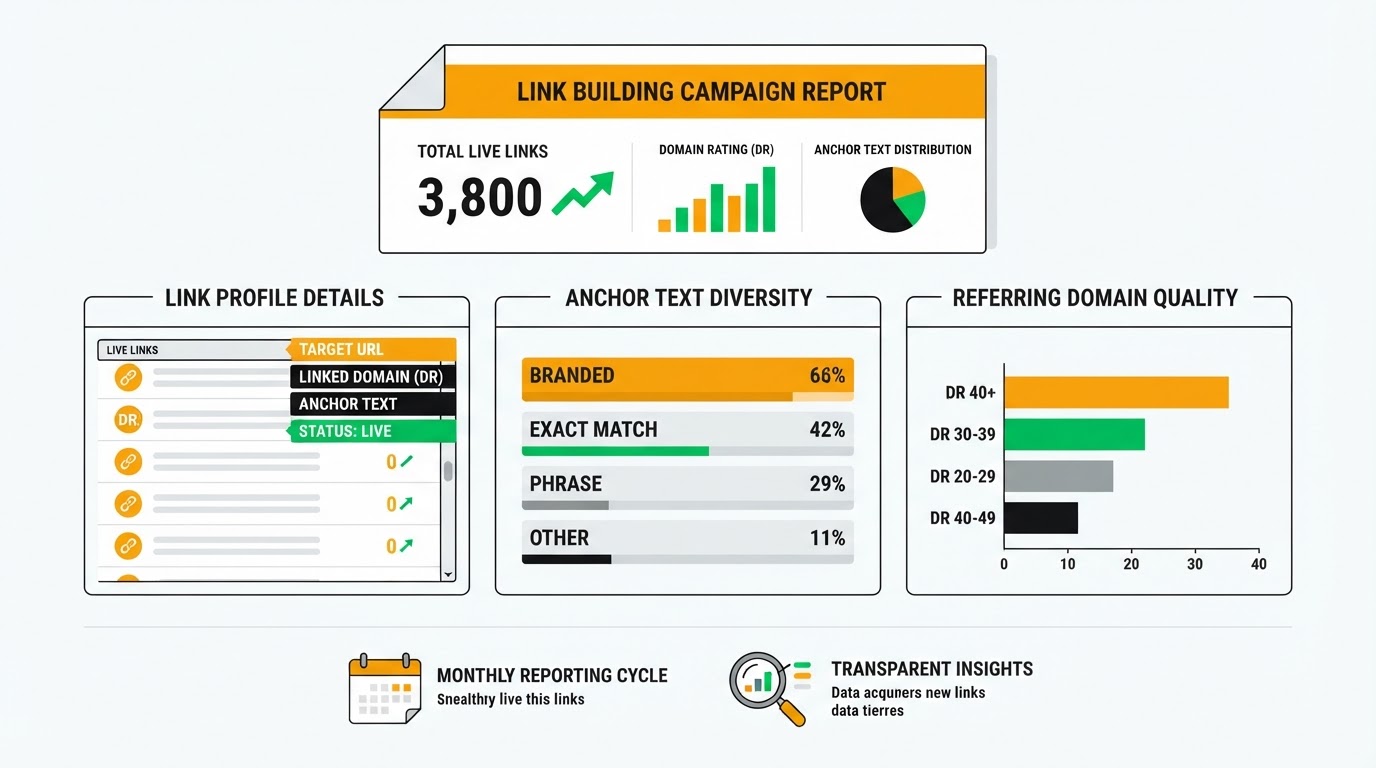
A monthly report should allow a marketing manager to verify each placement without asking for a separate explanation. A spreadsheet full of domain metrics falls short because it omits the facts needed to inspect the live result.
Require one row per placement. Include the live linking URL, the linking domain, destination URL, anchor text, publication date, link attribute where visible, placement format, and current status. Include the provider’s note when a link is pending, changed, removed, or awaiting replacement.
| Report field | Why it belongs in the report | Northstar Metrics example |
|---|---|---|
| Live placement URL | Lets the client inspect the actual context | example.com/product-analytics-guide |
| Destination URL | Confirms work supports the agreed page | /product/usage-analytics |
| Anchor text | Helps the team monitor anchor distribution | “usage analytics platform” |
| Publication date | Shows when the link became live | May 14 |
| Link status | Flags removals and replacements early | Live, pending, or replacement requested |
| Relevance note | Documents the editorial rationale | Article serves product analytics teams |
Export the report each month and keep a copy in your own analytics folder. Cross-check a sample of live links manually. Google Search Console’s Links report documentation explains why link data can vary by reporting source and why a provider report remains useful as an operational record.
For a broader review framework, use this backlink quality checklist before accepting early placements. It gives your team a common standard for deciding whether a link belongs in the campaign.
How Backlinks on Autopilot fits into a managed link building workflow
A provider should make the workflow visible before asking for a long commitment. At Backlinks on Autopilot, start by reviewing how the service works alongside your own target-page list. Use that conversation to establish the scope, relevance requirements, review cadence, and reporting expectations that your campaign needs.
Then bring Northstar Metrics’ three priority URLs, audience definition, and excluded site categories to the intake discussion. Those inputs turn a general request for links into a brief the provider can act on. The marketing lead can assess proposed opportunities against the agreed topical standards, confirm the destination page and anchor direction, and review the completed placements against the original scope.
This approach reduces ambiguity for both sides. The provider receives clear selection criteria. The client receives a record connecting each approved placement to a specific SEO objective. Check the available pricing options only after the deliverables and review workload are clear enough to compare packages fairly.
Confirm who owns earned links, content, and relationships
Ownership language protects your work when a campaign ends. The contract should state that live placements point to your website unless a publisher independently removes or changes them under its editorial rules. It should also explain who owns commissioned article copy, images, outreach collateral, prospect lists, and any publisher relationships developed during the engagement.
Ask whether the provider uses its own publisher network, outreach on your behalf, or a combination. Each model can work, though the exit terms differ. A provider-owned network may retain the publisher relationship, while your company should still retain the benefit of each live earned placement and copies of all final reporting.
For Northstar Metrics, the contract should provide a final export of every live URL, target URL, anchor, date, and placement status. It should also state the replacement period for links that vanish shortly after publication. Avoid promises of permanent placement when the publisher controls the page. Instead, require a clear process for monitoring removals and handling replacements within a defined period.
Common contract failures when buying managed link building
The most common failure appears when a service measures its work by link count alone. That metric invites low-effort placements and creates friction when the client expects relevance, approvals, and a durable record.
Watch for these contract gaps:
- “High authority” with no definition of relevance or editorial review
- A monthly number with no destination-page plan
- Reports that list domains while omitting live placement URLs
- Approval language that gives either party unlimited time to respond
- Replacement promises without a timeline or eligibility criteria
- No written terms for final reports, content rights, or campaign records
A short pilot can expose these issues early. Set a limited scope, approve a sample of prospects, inspect the first placements, and evaluate the report format. Continue only when the provider’s process gives your team enough visibility to manage risk.
FAQ about done-for-you link building
What should a done-for-you link building service deliver each month?
Expect a defined number of completed placements or a documented use of an agreed budget, plus placement-level reporting. The scope should identify destination pages, placement types, quality standards, approvals, and replacement rules.
Should I approve every backlink prospect?
Full approval works well for a small campaign, sensitive industries, and new provider relationships. A pre-approved set of rules can speed larger programs once the provider has shown consistent judgment. Set a response deadline so work does not stall.
Who owns backlinks after a link building contract ends?
Your website keeps the benefit of live links that publishers continue to host. The contract should give you a final record of those links and define rights to commissioned content and campaign data. Publishers retain editorial control over their own pages.
How long should I wait for the first link building report?
Ask for an initial prospecting or activity report during the first month, followed by reports as placements go live. Editorial timelines vary, so an early report should separate approved prospects, outreach in progress, pending placements, and completed links. See what to expect from a monthly backlink service in the first 90 days for a practical timeline.
Are guaranteed rankings a reasonable contract term?
Search rankings depend on many inputs, including content quality, technical health, competitors, and search demand. Use commitments tied to documented work, quality controls, reporting, and remedies instead.
A done-for-you link building contract should make it easy to inspect the work, approve the right opportunities, and retain a complete record of every placement. Bring your target pages and quality rules to the discussion first, then choose a provider whose process can meet them consistently.
Add backlinksonautopilot.com to your preferred sources in Google